
Your sales manager has read that competitors use AI to write emails, summarize calls and score leads, and she wants in before the quarter is out. Your channel manager has his arms folded: last year's "smart" software is still sitting untouched on the server, and he fully expects AI to join it. Then they both look at you. (An illustrative meeting, though you may well have chaired this exact one.)
We side with neither of them, and not out of diplomacy. AI is genuinely good at repetitive work with words: first drafts, call summaries, tidying up customer information. Building relationships, negotiating and answering to a customer are still jobs for people. The enthusiast is right about the first half, the skeptic about the second, and last year's software most likely failed because it was handed the wrong job on day one.
What AI does well
Generative AI (the kind that produces text, images or tables from your instructions) is especially strong with language. McKinsey's research on how companies use generative AI shows marketing and sales among the most active functions, with drafting text as one of the common uses. In a small or mid-sized sales team, we suggest testing three groups of tasks first:
- Drafting: introduction emails, check-in messages, proposal summaries for customers.
- Summarizing: call notes, customer meeting minutes, and email threads so long nobody wants to scroll back through them.
- Classifying: tagging inbound messages (price question, warranty question, complaint) and ordering them by criteria you set yourself.
All three end in a draft for a person to check, never in a final decision. They are also the jobs that swallow many teams' Friday afternoons, when everyone is retyping call notes and updating the tracker in time for Monday's meeting.
What people still need to do
Think of AI as a brand-new assistant who is remarkably quick: types at lightning speed, never complains about overtime, but has never once sat down for coffee with a customer. This assistant doesn't know the context you haven't shared, and now and then writes something that sounds perfectly reasonable and is simply wrong. So keep these with people:
- Building and keeping relationships, especially with B2B buyers who come back year after year.
- Negotiating price, terms and discounts.
- Final decisions: accepting or declining an order, committing to a delivery date.
- Anything that carries a legal commitment, a figure or a price.
AI may prepare. Only people may commit.
A task-sorting table in three levels
To make this concrete, we've placed the team's everyday tasks in a table, along with who is accountable for each.
| Task | Level handed to AI | Who is accountable |
|---|---|---|
| Drafting follow-up emails from a template | AI drafts, person edits and sends | Sales rep |
| Summarizing calls and meetings | AI summarizes, person cross-checks | Sales rep |
| Tagging inbound messages | AI suggests, person confirms | Team lead |
| Scoring prospects | AI assists using criteria you define | Team lead |
| Quotes and contracts | Person writes, AI only proofreads | Manager |
| Negotiating and closing | Person | Manager, owner |
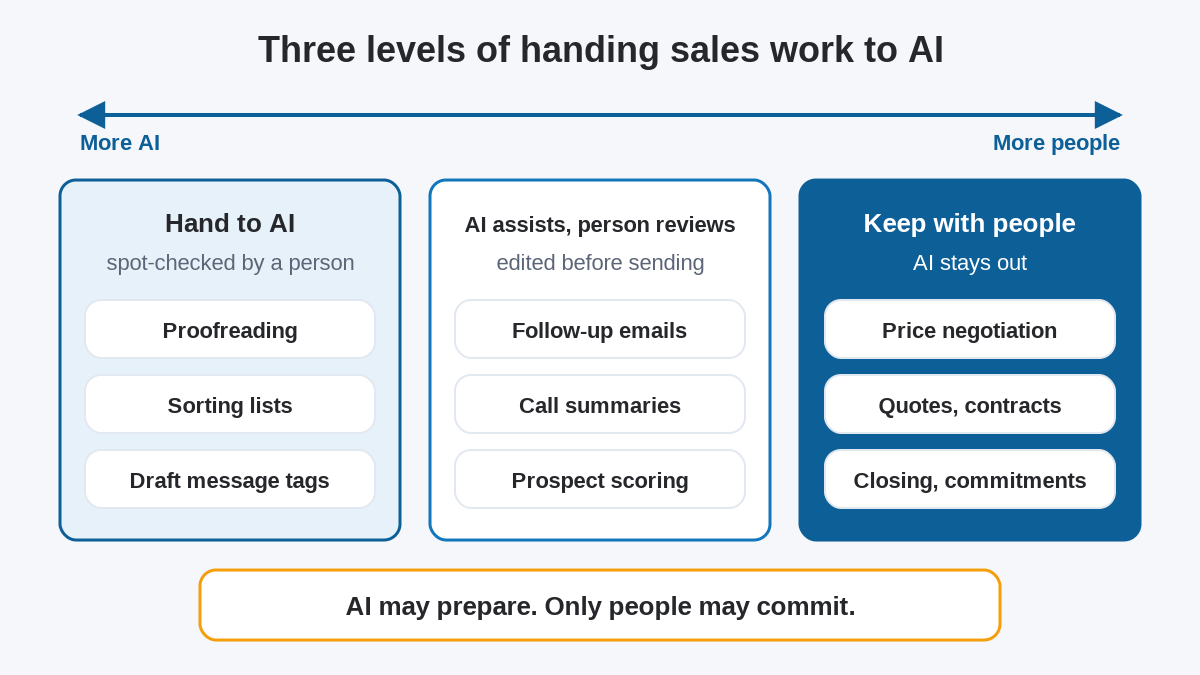
Treat the table as a starting point. Every business adjusts it to its own risk, and you'll come back and redo it once you've finished the series.
Three beliefs that sound right and aren't
You'll hear these three at almost every tech event, usually delivered with great confidence.
- "Buying an AI tool means selling more." A tool only makes an existing process run faster. If your process is still fuzzy, head to lesson 2.
- "AI already knows my customers." AI knows only what you give it. When customer data is scattered across chat apps, notebooks and people's heads, AI can't do much with it. That's the subject of lesson 3.
- "AI is never wrong." AI can invent details, from prices and features to customer names. That's why everything sent outside the company needs a human reviewer, and lesson 5 gives you a concrete review routine.
For a broader overview, see our article AI in sales for SMEs.
Four questions before you hand a task to AI
Before giving any task to AI, take two minutes to ask yourself:
- If the draft is wrong, who will catch it, and before what point?
- Does the task involve customers' personal data? If so, have you masked what isn't needed?
- Is there a sample of "what good looks like" for the reviewer to compare against?
- Can you measure time or quality before and after?
If the second or fourth question is still open, sort that out first. A surprising number of expensive habits start with a casual "let's just try it" that nobody wrote down.
Choosing the first task to try
So where do you start? We suggest picking a task that passes three gates: it repeats every week, it eats the time of your best people, and if something goes wrong, a reviewer can still catch it before it reaches the customer.
Take Hung, the sales lead at a 20-person materials distributor in Bac Ninh (illustrative). Every morning his best rep spends about an hour rewriting appointment schedules and sending reminder emails. That's an excellent candidate: repetitive and easy to check. Letting AI answer complaints from a major customer on its own, on the other hand, is not a good idea yet. An annoyed key client who receives a beautifully written reply with the wrong details can turn a small problem into a big one fast.
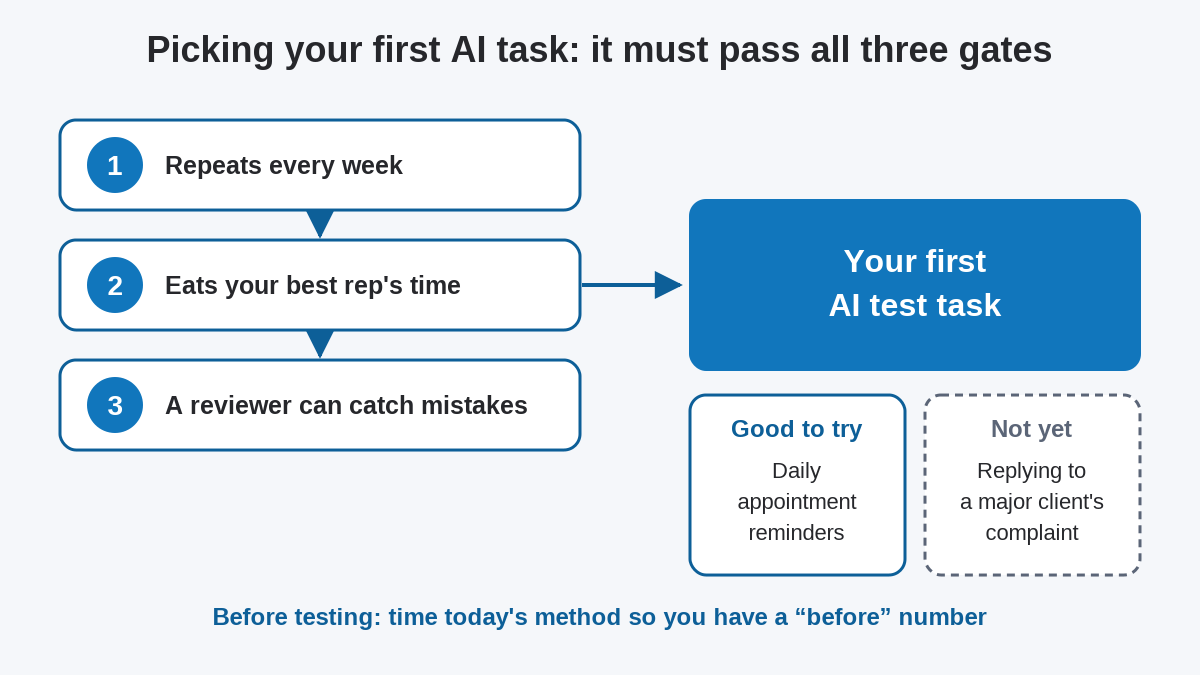
Before you test, time how the task is done today. Without a "before" number, nobody will know for sure whether AI really helped, and the review meeting quietly turns into a contest of who has the strongest gut feeling. We come back to measurement in lesson 6.
Practice exercise
Give it about 45 minutes and you'll walk away with your first map of where AI can help your team.
- With your team, list 10 tasks people do in a typical week (hints: prospecting, calling, messaging, quoting, meetings, updating figures, payment reminders).
- Place each task in the table above using three levels: "hand to AI", "AI assists, a person reviews" and "keep with people".
- Pick exactly one "AI assists, a person reviews" task as your test candidate. Measure the minutes per run and the runs per week.
- Save the result in a spreadsheet; you'll use it again in lesson 2.
Once you multiply minutes by weekly runs, you may be surprised: those "small" tasks often add up to a full half-day of your best person's week. And every hour you win back is one more hour they can spend in front of a real customer.
How Kingsley Asia can help
The slowest part of this lesson is usually agreeing which task belongs at which level, especially with an enthusiast and a skeptic in the same room. Kingsley Asia can be the neutral party in that session: sorting the task list with your team, choosing the first test and measuring the "before" number, as part of our Sales & marketing excellence and Business strategy & operations services. A few lines about your current team through our contact page is enough to start.