
A motorbike trip with nothing but a phone for navigation is great fun, right up until the phone dies halfway up a mountain pass. That's when the group discovers everyone remembered the road differently, and nobody is quite sure where they are.
Plenty of sales teams ride the same way. Tomorrow morning, ask three of your reps separately "which customers are at the interested stage?" and lay the three lists side by side. The month-end pipeline report will still look beautifully tidy. Nobody in the room would bet their bonus on it.
Why the map comes before AI
A sales process map is a single page describing the stages a customer passes through, from first hearing about you to paying and coming back for more; who does what at each stage; and when a deal is allowed to move to the next one. With the map in front of you, it becomes obvious where AI belongs, and the candidate task you picked in lesson 1 finds its place on the road from stranger to regular customer.
In many SME sales teams, the "process" does exist. It just lives in the head of the best salesperson. One rep calls a customer "interested" the moment they text "send me a quote", while another only counts it once a meeting is booked. The result is that pipeline figures (the list of sales opportunities you're pursuing) stop being trustworthy, and any AI tool learning from that skewed data will be skewed too, sometimes with remarkable confidence.
CRM platforms' own documentation follows the same logic. A pipeline is a chain of stages showing where an opportunity sits in your process, and each stage should be defined by the business itself. The tool simply offers a default set for you to adjust to reality. For more on this, see our articles on the B2B sales funnel and the B2B sales process.
Think of the map as your team's shared language, like the drawings that the architect, the builder and the homeowner all look at while a house goes up. When a manager says "we have 12 deals at stage 4", everyone in the room should picture the same situation. Otherwise reports are just opinions, and coaching becomes guesswork.
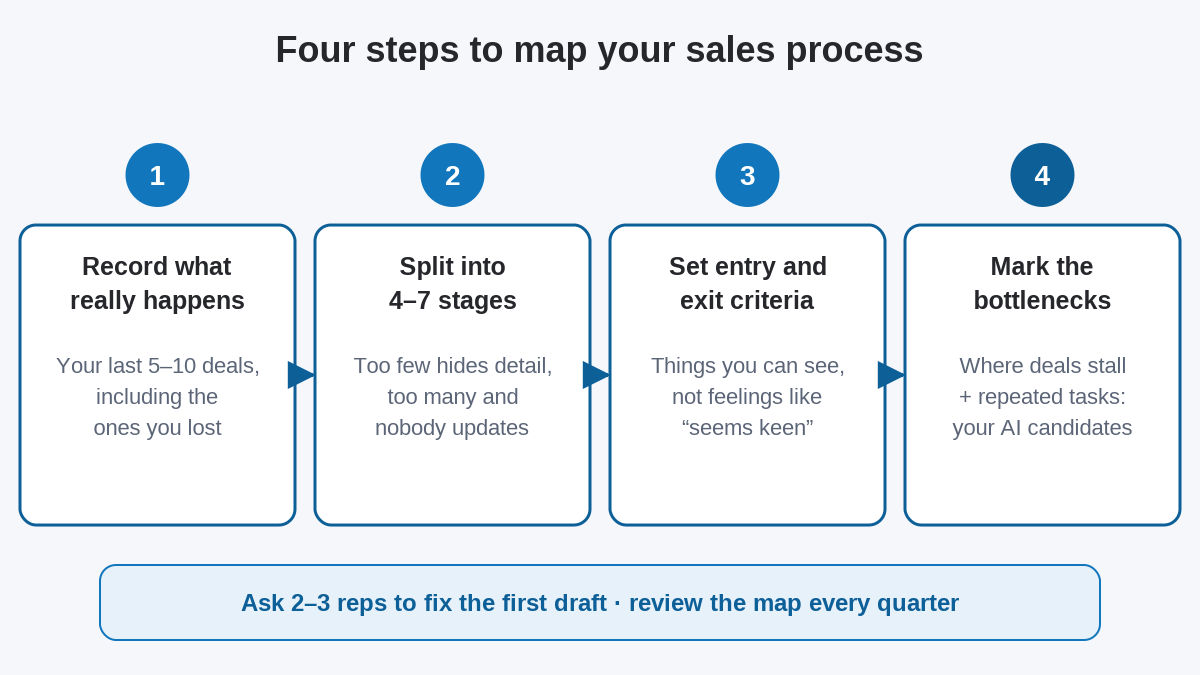
Four steps to map your sales process
It sounds like a consultant's job, but all you really need is one afternoon, a whiteboard and these four steps.
- Record what really happens, not the theory. Take your last 5 to 10 deals, won and lost, and trace them back: where the customer came from, who reached out first, which step took the longest.
- Split into 4 to 7 stages. Fewer, and you lack the information to manage; more, and the team stops bothering to update.
- Set entry and exit criteria for each stage. A criterion must be something you can observe, such as "the customer confirmed the budget in writing", not a feeling like "the customer seems keen".
- Mark bottlenecks and repeated tasks. A bottleneck is where deals sit too long or fall out. Repeated tasks are your AI candidates.
A fill-in template for your map
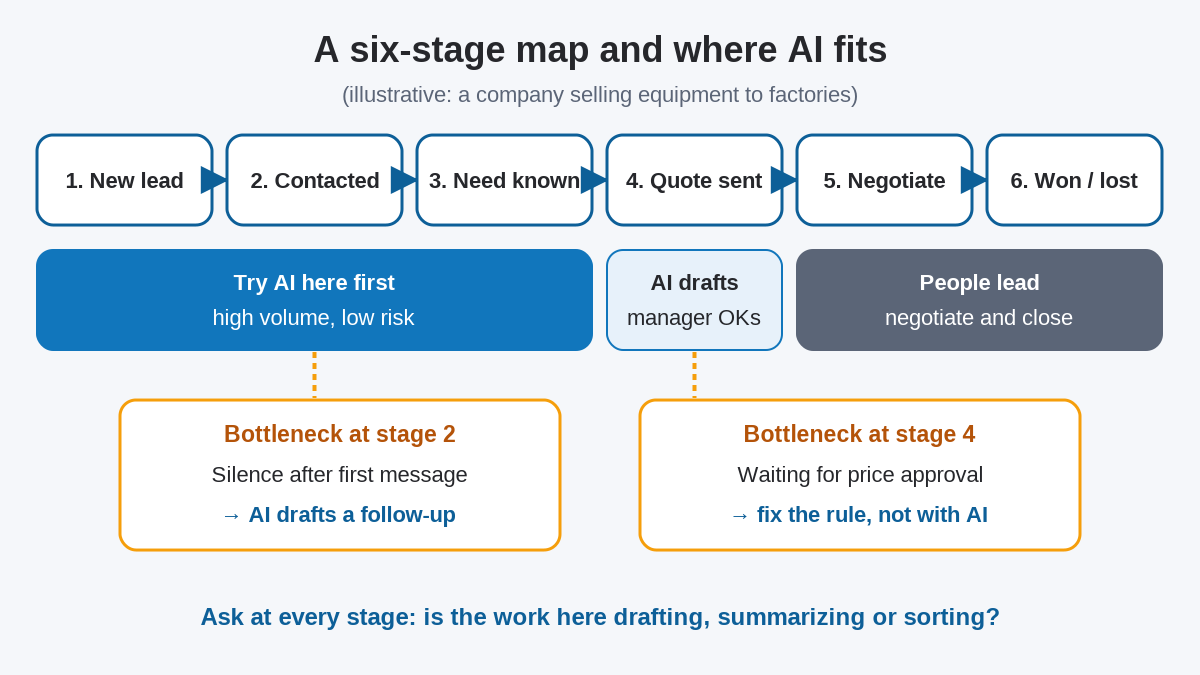
Mai is the director of a company selling equipment to factories in Long An (illustrative). After one afternoon with her team, she ends up with the table below. Swap in your own reality.
| Stage | Entry criterion | Owner | Repeated tasks | Common bottleneck |
|---|---|---|---|---|
| 1. New prospect | Name, company, contact channel known | Sales rep | Entering details, researching the company | Missing or duplicate data |
| 2. Contacted, responded | Customer replied or picked up | Sales rep | Writing intro messages, booking calls | No reply after first message |
| 3. Need confirmed | Need, volume and timing known | Sales rep | Writing call notes | Key questions not asked |
| 4. Proposal or quote sent | Quote sent | Rep + manager | Drafting the proposal | Waiting for internal price approval |
| 5. Negotiation | Customer responded to the quote | Manager | Summarizing rounds of discussion | Customer goes quiet after the quote |
| 6. Won / lost | Order placed or clear refusal | Manager | Logging win/loss reason | Loss reasons not recorded |
The "Repeated tasks" column is your candidate list for the lessons ahead. The "Common bottleneck" column, on the other hand, tells you where to fix the process first, not where to try a tool.
Putting AI in the right place on the map
With the map in hand, walk through each stage and ask one question: is the work here drafting, summarizing or sorting? If so, that's where AI can help. But if the bottleneck is "waiting for internal price approval", AI won't unblock it, because what you need is a faster approval rule. Using technology to solve an internal policy problem is a bit like buying top-of-the-range running shoes when the reason you're always late is that your alarm is set to the wrong time.
A simple way to set the order is to start at the top of the funnel (stages 1 to 3), where volume is high and risk is low. Lesson 4 uses these very stages to score prospects. Work at the bottom of the funnel, such as negotiating and closing, should stay with people.
Where first maps usually go wrong
A messy first map is normal; every map needs a few rounds before it earns its keep. These five mistakes come up more than any others.
- Too many stages: with 12 stages, almost nobody updates anything. Merge them.
- Stages described by feelings: "interested", "hot lead". Replace them with observable actions.
- No loss reasons: if you don't know why you lose, you have no data to improve. Add a short list of loss reasons (price, timing, competitor, no need, went silent).
- Drawn once, then filed away: review the map every quarter, especially when you change products or open a new channel.
- The owner draws it alone: owners tend to draw the ideal process, while the team lives with the real one every day. Invite two or three reps to correct the first draft; they know exactly where deals get stuck, including the places the weekly report never mentions.
Practice exercise
Set aside 60 to 90 minutes, ideally with two or three people from the team. You'll come out of it with a first map that everyone reads the same way.
- Pick your 5 most recent deals, including at least 1 you lost. For each, note the date of every step from first contact to final outcome.
- From that, settle on 4 to 7 stages and write the entry criterion for each, using the template above.
- Highlight the 2 biggest bottlenecks and the 3 most time-consuming repeated tasks.
- Compare with the candidate task you chose in lesson 1: which stage is it in? Save the map, because you'll use it to design your data fields in lesson 3.
A small tip: snap a photo of the whiteboard and post it in the team chat right after the session. A map everyone has seen is far harder to forget than one that lives only on the boss's laptop.
How Kingsley Asia can help
An outsider tends to spot bottlenecks faster, simply because they haven't got used to them yet. We can trace your recent deals with the team, settle the stages and write stage-change criteria that everyone reads the same way; that work sits within our Sales & marketing excellence service. Once you have that first whiteboard photo, send it our way and we'll look at it with you.