
6 lessons · Beginner → Intermediate
Optimizing Small Business Sales with AI
Six hands-on lessons for owners and sales leads: set up a tidy sales foundation first, then bring in AI where it truly helps, safely and measurably.
Start learningBy the end of these six lessons you will have four concrete things in hand: a one-page sales process map, a tidy set of customer data the whole team can share, a lead scoring frame with sample prompts for follow-up content, and a short list of metrics that tells you whether AI is really helping. Modest as that sounds, plenty of businesses are missing at least one of the four, even though somebody tells them every week to "get AI into sales right now, before you fall behind".
You'll notice the series runs in the opposite order to most tool advertising: foundation first, AI second. That's because AI multiplies whatever you already have. A clear process gets faster with AI. A messy one gets messy faster, and looks slightly more professional while doing it.
Who this series is for
Two readers were on our minds while we wrote.
- The first is the owner of a small or mid-sized business who directly manages a sales team of two to a few dozen people, and wants to know where the money for any new tool will actually go.
- The second is a sales lead or manager who wants to standardize how the team works before buying one more piece of software.
If you recognize yourself in either of them, read on.
The six-lesson path
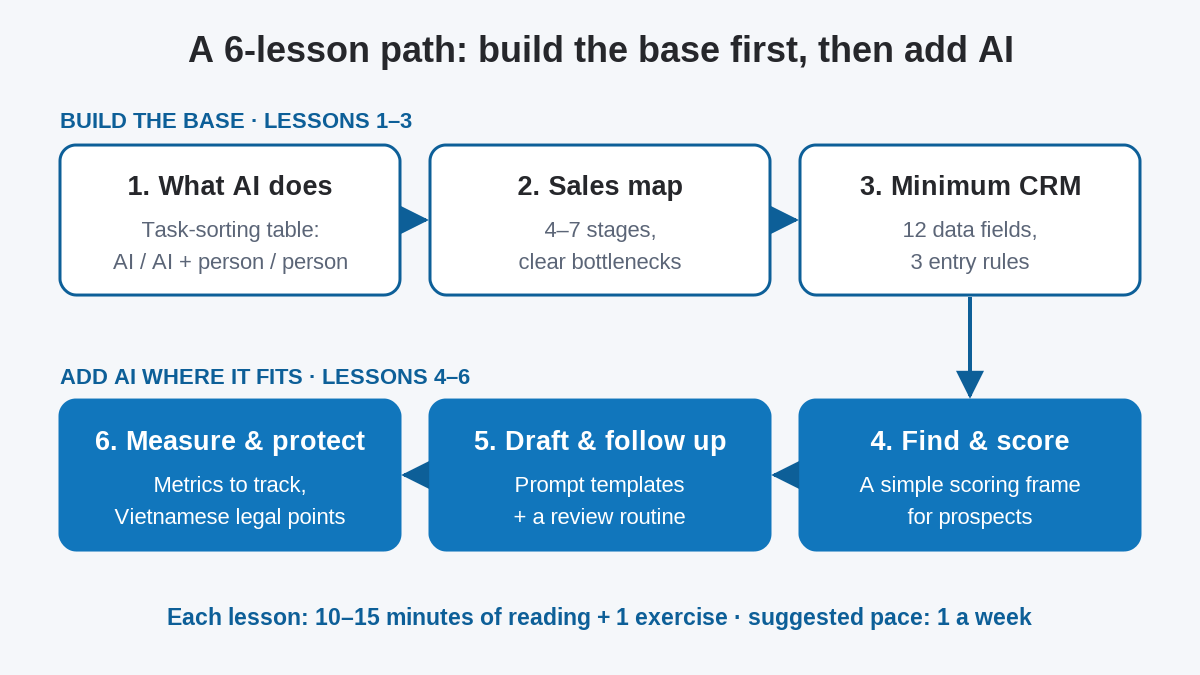
Six lessons, each one a step on the ladder, and each building on the output of the last. The first three lay the foundation; the last three put AI exactly where the ground is ready for it.
- What AI really does for sales teams: which tasks to hand to AI and which to keep with people.
- Mapping your sales process: draw the real stages and the real bottlenecks of your business.
- The minimum CRM before AI: the must-have data fields and the entry rules that keep data clean.
- AI lead finding and scoring: a simple scoring frame, and where AI genuinely helps.
- AI for sales content and follow-up: prompt templates and a review routine before anything leaves the building.
- Measuring, scaling and data privacy: the metrics to track and the Vietnamese legal points to watch.
A good tool can't fix a bad process. It just helps the bad process run faster.
How to get real results from the series
Most online courses meet the same fate: two sessions devoured, the rest saved for "when things calm down", and things never quite calm down. So each lesson here takes 10 to 15 minutes to read and ends with a practice exercise you can finish within the week.
Do the exercises with your real business data, masking sensitive details where needed. One lesson a week is a sensible pace: enough time to try things with your team, hear what they think, and only then climb the next step. The content isn't tied to any product, so it works with the software you already use, spreadsheets included.
Before you close this page, put a 30-minute block in your calendar for next Monday morning and call it "Lesson 1 with the team". Things that have a name in your calendar tend to get done; things that live only in your intentions tend to wait in line, sometimes until next year.
The starting point is lesson 1: what AI really does for sales teams.