
Here is a message drafted by an AI that was given no context at all:
"Dear Valued Customer, we hereby wish to inform you that your quotation awaits your response. Kindly review at your earliest convenience so that we may assist in a timely manner." (illustrative)
Robotic, isn't it? Sent to a coffee chain owner you sat down with only last week, it would land even worse. Now tell the AI who he is, when you last spoke and how your company usually talks, and ask again. It takes about a minute, and you might get this:
"Hi Phong, we're guessing the quote we sent last week got buried under the daily rush at the shop. Is there anything you'd like us to adjust?"
Same tool, same customer. Everything that separates those two messages came from the minute you spent telling the AI the story.
The five parts of a good prompt
AI drafts follow-up content best when it has enough context, one clear task and a person reviewing the draft before it goes out. The context lives in your prompt (the text you type to tell the AI what to do).
Think about ordering at a coffee shop. Ask for "a coffee" and you could get anything from a strong black iced coffee to a sweet milky one. Ask for "a bạc xỉu (milky iced coffee), less sugar, less ice, to go" and you will almost certainly get exactly what you wanted. Briefing AI works the same way: it cannot read your mind, only what you type.
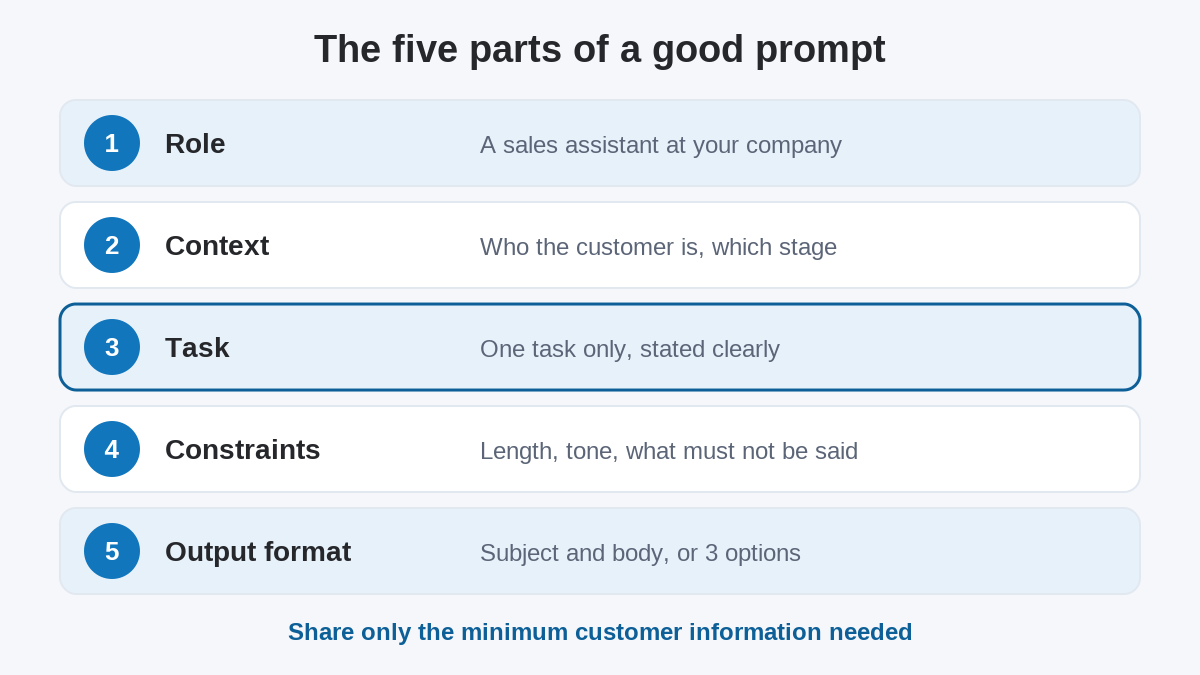
A useful prompt usually has five parts:
- Role: "You are a sales assistant at [company], which sells [product]."
- Context: who the customer is (title, industry), which stage they are in, and what was said last time.
- Task: one task only, for example "write a reminder email 5 days after the quote was sent".
- Constraints: length, tone (polite, concise), form of address, and what must not be said (no price promises, no delivery promises).
- Output format: subject and body; or a table; or three options to choose from.
One habit worth building from day one: give only the minimum customer information the task needs. Name, title and industry are usually plenty; phone numbers, addresses and bank details are things the AI simply does not need.
Four sample prompts grounded in real SME work
These prompts feed on the high-scoring group from lesson 4 and the CRM data you built in lesson 3. To keep them concrete, they are written for Khoa, who runs an 18-person company in Ho Chi Minh City supplying commercial water filtration systems and scheduled filter replacement to restaurants and cafes (illustrative). Replace the bracketed parts with your own business details.
Prompt 1: reminder email after sending a quote
You are a sales assistant at [company], which supplies commercial water filtration systems and scheduled filter replacement to restaurants and cafes.
Context: 5 days ago I sent a quote for installation plus 12 months of maintenance to [name], who owns a chain of 3 coffee shops. In our meeting he cared most about whether installation would disrupt opening hours. No reply yet.
Task: write a gentle reminder email, maximum 120 words, in Vietnamese, with the business referring to itself as "chúng tôi" (we) or "[company name]" and addressing him as "anh"; never use "em".
Constraints: do not mention discounts, do not promise delivery times, end with one easy-to-answer question (for example whether a 15-minute call suits him better on Thursday morning or Friday afternoon).
Return 3 subject line options and 1 body.
In Vietnam, forms of address carry real weight. Notice that the prompt has the business speak as "chúng tôi" (we) or by its company name, while still addressing the customer warmly as "anh" or "chị". The message speaks for the whole company, not for one rep, so "we" stays professional and consistent no matter who is typing. It does not have to sound distant either: what made the opening example robotic was "Dear Valued Customer" and "we hereby wish to inform you", not the pronoun. Spell the form of address out in the prompt, or the AI may default to something that reads like a government notice, or slip into the casual "em" common in online sales chat.
Prompt 2: summarize call notes
Below are rough notes I typed on my phone after a call with a restaurant owner (personal data removed; abbreviations and messy wording likely).
Summarize into: (1) main need, (2) concerns or objections, (3) decision maker and approval process if any, (4) next step with a proposed date.
Use only information in the notes. If an item is missing, write "unclear" instead of guessing.
[Paste notes]
Prompt 3: reply options when a customer hesitates on price
The customer messaged: "Your price is a bit higher than another supplier, let me think about it." They are at the [quote received] stage and care most about [steady water quality and fewer repair call-outs].
Suggest 3 replies with different tones (empathetic, value-based, clarifying question), each at most 60 words, in a natural messaging style; the business refers to itself as "we" or "[company name]" and addresses the customer as "chị".
Do not offer any discount or commitment. Flag which parts need manager approval.
Prompt 4: a three-message nurture sequence
Write a sequence of 3 short messages (max 60 words each) sent 7 days apart to [restaurant owners who requested a quote at a food and beverage trade fair and agreed to receive messages on this channel] who did not respond after first contact.
Each message gives a different value: (1) a useful tip about [how to tell when a filter needs replacing], (2) a question about their current challenge, (3) an invitation to a 15-minute chat.
The business refers to itself as "we" or "[company name]" and addresses the customer as "anh/chị". End each message with a line letting the customer opt out of further messages. No hype, no promised results.
Whenever a prompt works well, save it in a shared team document. Within a few weeks you will have your own prompt library, and customers will hear one consistent voice whether the person typing joined last month or five years ago.
A review routine before sending
Treat every AI draft like work from a bright new intern. It arrives fast and reads smoothly, yet now and then it gets the customer's name wrong or confidently promises something your company never offered. You would not let an intern email a key account unread, would you?
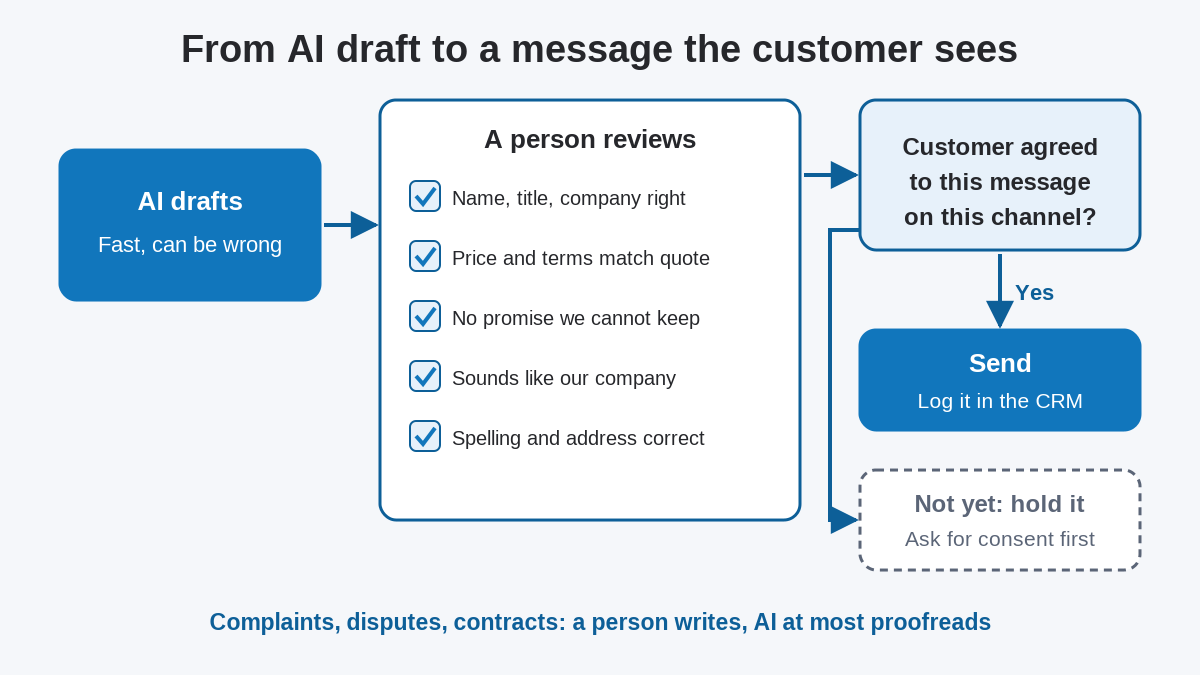
So give the reviewer (who may well be the sender) a short checklist:
- Are the customer's name, title and company right? AI can mix up or invent details.
- Do the price, timing and terms match the quote and current policy?
- Is there any promise we are not sure we can keep? If so, delete it.
- Does the tone match how the company normally speaks to customers? Any robotic or cliché lines?
- Has this customer agreed to receive this kind of message on this channel? (see below)
- Vietnamese text: are diacritics, spelling and forms of address correct?
For sensitive content such as complaints, payment disputes or contracts, a person should write it, and AI at most proofreads. You can also compare this with the process in our article After-sales customer care process.
AI writes the draft. A person signs it.
This week, print the checklist on a small card and stick it beside each team member's screen. Those six questions take under a minute to read, and they can save you an afternoon-long apology call.
Consent and sending hours
This part is a little dry, but please read it carefully, because this is where even a beautifully written message can turn into a problem for the business.
Excellent content cannot make up for sending in breach of the rules. In Vietnam, promotional messages and calls fall under the anti-spam rules for messages, emails and calls (according to Decree 91/2020/ND-CP, in force since 1 October 2020, as published by Thu Vien Phap Luat and VCCI, and related rules). According to that decree, the core principles are: send advertising messages, emails and calls only with the recipient's prior consent; do not send to numbers on the do-not-advertise list; give recipients an easy way to opt out; and keep evidence of consent (under Article 11, for at least one year). Any sending-hour or volume limits that apply to your channel should be checked in the current text. As published by the Ministry of Public Security (09/2026), a draft decree to replace Decree 91/2020 is out for consultation; at the time of writing we found no issued replacement and implementing guidance has not yet been issued, so check the current text before running a large campaign. According to LuatVietnam's analysis (2025), the 2025 Law on Personal Data Protection (Article 28) also requires customer consent when personal data is processed for advertising services; we go deeper in lesson 6.
Note: The legal information in this article is a summary based on the Kingsley Asia team's analysis of documents and sources published at the time of writing (11/2026). Policies may change; please confirm with a lawyer or accountant before acting on it.
Practice exercise
One morning is enough. By lunchtime you will have your first AI-drafted message that you have reviewed properly yourself, plus a prompt tailored to your own business.
- Pick 5 high-scoring prospects from lesson 4. For each, check the "consent record" column in your CRM; anyone without one stays out of this batch for now.
- Use prompt 1 or prompt 4 (filled in, with unnecessary personal data removed) to produce drafts. Run each prompt twice and compare the results.
- Apply the review checklist and record where the AI was wrong or added details of its own. How many minutes did the fix take compared with writing from scratch?
- Update the prompt to prevent the error you found (for example add "do not guess product names") and save the best version to the team's prompt library.
Hold on to that number of minutes from step 3. In lesson 6, that small figure helps answer the biggest question of the whole series: is AI really helping your team?
How Kingsley Asia can help
A prompt library is only worth having if it sounds like your company. We help sales teams write their own prompts in their brand voice, set up a pre-send checklist, review how consent to receive messages is collected and stored, and train staff to use all of it day to day. More on our Sales & marketing excellence page, or drop us a note with one message your team sends today.
Sources
- Thuvienphapluat, Decree 91/2020/ND-CP on fighting spam messages, spam emails and spam calls (2020)
- VCCI, Text of Decree 91/2020/ND-CP on fighting spam messages, emails and calls (in Vietnamese, 2020)
- Ministry of Public Security, Draft decree replacing Decree 91/2020/ND-CP (in Vietnamese, 2026)
- LuatVietnam, Comparison of the 2025 Law on Personal Data Protection and Decree 13/2023/ND-CP (2025)
- McKinsey, AI-powered marketing and sales reach new heights with generative AI (2023)