
"Boss, I pasted our customer list into ChatGPT so it could sort it for me. Is that a problem?" One of your reps leans over your desk with that question, just before lunch.
It could be, and the first thing to do is ask them to stop for now. That list is your customers' personal data. Pasting names, phone numbers and emails into a personal AI account moves the data out of the company's control, quite possibly onto servers abroad, under terms nobody on the team has read. Using AI to sort customers is fine in principle: swap names for customer codes, drop the columns the task doesn't need, use a work account with clear data commitments, and make sure the processing falls within what customers agreed to (the legal section below has the detail).
Note: The legal information in this article is a summary based on the Kingsley Asia team's analysis of documents and sources published at the time of writing (11/2026). Policies may change; please confirm with a lawyer or accountant before acting on it.
What to measure
The second question usually arrives a few months into the trial, in a meeting: "So, is AI actually helping?" One person says "much faster", another says "it's okay", a third just smiles. That question and the one at the top of this page share a root: nobody set the rules and nobody measured anything at the start. This last lesson draws on everything you've built, from the candidate task in lesson 1 to the stage map from lesson 2, the CRM from lesson 3, the scoring frame from lesson 4 and the follow-up content from lesson 5.
Anyone who has tried to lose weight remembers the first step: standing on the scale. Without that morning's number, three months of effort later all you can say is "my trousers feel a bit looser, I think". Measuring AI in sales works the same way. The "before" number matters every bit as much as the "after".
Choose a few metrics you can pull from the CRM you have already built. We suggest a set in three groups:
| Group | Metric | How to calculate |
|---|---|---|
| Efficiency | Average time per task (drafting an email, summarizing a call) | Minutes per run, against the baseline from lesson 1 |
| Time from new lead to first contact | Hours or days, from the CRM | |
| Sales results | Stage-to-stage conversion | Opportunities moving to the next stage divided by those entering the previous one |
| Win rate and sales cycle length | Won/(won+lost); days from first contact to close | |
| Quality | Share of AI drafts needing heavy edits; errors caught by reviewers | Count during a two-week trial |
| Share of CRM rows with all required fields | From the baseline in lesson 3 |
Two cautions will stop you fooling yourself. First, do not credit every change in revenue to AI: market, season and price all play their part, much as a farmer with a bumper harvest cannot thank the new fertilizer alone in a year when the rains came right on time. If you can, test on one group of prospects or one rep and keep the rest as a comparison. Second, promise no figures before you have your own data. If quality metrics worsen (more errors, customer complaints), stop and fix things before you scale.
Measure before you celebrate. Start small before you scale.
This week, pick just 3 metrics from the table and write down today's numbers. Turning those numbers into individual targets is covered in our article How to set sales KPIs for SMEs.
Five steps from small trial to scale
A well-loved restaurant rarely puts a new dish on the menu on day one. The chef cooks it for a few regular tables, listens, adjusts the seasoning, and only then prints it on the menu. Bringing AI into your sales team deserves the same rhythm, one step at a time:
- Small trial (2 to 4 weeks): one task, one or two people, and a human reviews every output.
- Evaluate: compare metrics with the baseline; record the errors you hit and how you fixed them.
- Standardize: write a one-page guide covering which tool, which prompts, which data may and may not go in, and who reviews.
- Expand: add people, then a second task. Add only one change at a time.
- Review regularly: each quarter, revisit the sorting table from lesson 1, the scoring frame from lesson 4 and the list of tasks never to hand to AI.
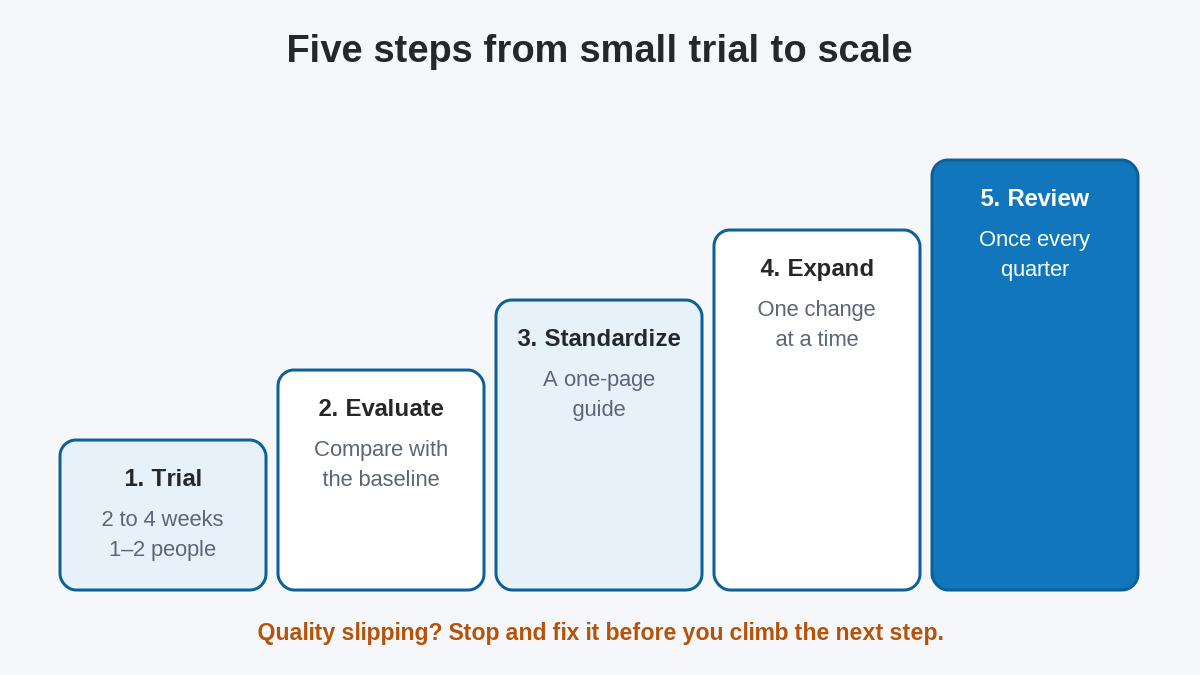
Does step 4 feel slow? That is deliberate. Change three things at once and see results dip, and your team will spend a week guessing which change caused it. Change one thing at a time, and the answer usually shows up right there on the metrics sheet.
Personal data: the legal picture in Vietnam
Here is a way to think about it. When a customer hands your team a phone number, it is a bit like a neighbor leaving you their house key while they go home for Tet. You have been trusted, but that does not mean you can lend the key to anyone you like. Current personal data protection rules follow a fairly similar spirit, with many specific requirements. The points that follow stay close to the wording of the texts and sources cited, so you can check them easily.
When your sales team puts customer information into a CRM, an AI tool or a mailing list, that is personal data processing. According to the sources listed under "Sources" (Government Gazette, LuatVietnam, EY Vietnam):
- According to LuatVietnam (2025), Decree 13/2023/ND-CP was the first comprehensive rule on personal data protection. As published in the Government Gazette, the Law on Personal Data Protection No. 91/2025/QH15 (passed by the National Assembly on 26 June 2025) and Decree 356/2025/ND-CP (issued 31 December 2025) raise the framework from 1 January 2026. Under Article 42(2) of Decree 356, Decree 13/2023 ceased to have effect on 1 January 2026.
- Data subject rights: according to Article 4(1) of Law 91/2025/QH15 (Government Gazette, 2025), your customers have rights that include: knowing how data is processed, consenting or refusing, withdrawing consent, viewing and correcting, requesting a copy, deletion or restriction, objecting to processing.
- Consent: according to Article 6 of Decree 356/2025/ND-CP as published in the Government Gazette, the consent method should allow verification of who agreed, when and to what; the controller is to keep evidence and bears the burden of proof in a dispute; default consent and prompts that blur agreement and refusal are not allowed. For sensitive data, the person is to be told it is sensitive. This is why field 12 exists in lesson 3.
- Advertising: according to Article 28(3) of Law 91/2025/QH15 (Government Gazette, 2025), processing customers' personal data for advertising services requires the customer's consent.
- Deadlines for customer requests: according to Article 5 of Decree 356/2025/ND-CP (Government Gazette, 2025), a business is to respond within 2 working days and complete each request type within set time frames (for example 10 days to give access or correct data and 20 days to delete it, longer if a processor or third party is involved). Prepare a responsible person and a reply routine in advance.
- Relief for small businesses: according to Article 38 of Law 91/2025/QH15 and Article 41 of Decree 356/2025/ND-CP (Government Gazette, 2025), small enterprises and startups may choose whether or not to apply Articles 21, 22 and clause 2 of Article 33 of the Law (which, in EY Vietnam's analysis (2026), relate to impact assessment dossiers and appointing a data protection unit or person) for 5 years from 1 January 2026; household businesses and micro-enterprises need not apply those provisions. The relief does not apply if the business provides personal data processing services, directly processes sensitive data, or, from the point when the cumulative data it has processed reaches 100,000 or more data subjects. The same sources indicate it covers only some obligations; core duties such as consent, security and honoring customers' rights still apply.
- Sending data abroad: many AI tools run on servers overseas. According to Article 20(2) of Law 91/2025/QH15 (Government Gazette, 2025), a business transferring personal data abroad is to prepare a cross-border transfer impact assessment dossier and send it to the specialized authority within 60 days of the first transfer (unless exempt); Decree 356/2025/ND-CP sets out the dossier and procedure in more detail. Whether feeding customer data into an overseas AI tool falls under this depends on the exact method and data, and clear guidance for that specific situation has not yet been issued, so ask a legal adviser.
- Penalties: as reported by the Government Newspaper (2026), Decree 330/2026/ND-CP (effective 19 August 2026) sets administrative penalties for cybersecurity and personal data protection violations; look up the current fine levels in the official text rather than relying on rumor.
If that list leaves your head spinning a little, that is completely understandable. The texts hold plenty of detail that a specialist should check against your own situation; even so, you can start today with a few habits any decent sales team should have had all along: ask before you send, record it when a customer agrees, and use only what you truly need.
Rules for using AI safely in sales
From the legal picture above, we have drawn seven everyday working rules you can apply right away, even if your sales team is just three people:
- Minimize: put into AI only what the task needs. Replace names with customer codes; drop phone numbers, emails and addresses when not needed.
- Choose plans with data commitments: read the provider's policy. For example, OpenAI states that for its business plans and API, inputs and outputs are not used to train models by default; free or personal plans often differ. Each provider has its own policy, so read the terms of the tool you use.
- Separate work accounts from personal ones: staff must not paste customer data into personal accounts.
- Keep sensitive data out (health, detailed finances, identity documents) of AI tools until there has been legal review.
- Record consent from the point of collection (website forms, business cards, calls) and store it in the field from lesson 3.
- Name a contact and a routine for answering customers' requests to view, correct or delete data; set a rule for deleting data no longer needed.
- Train the team and write a one-page internal guide, with a signed acknowledgment.
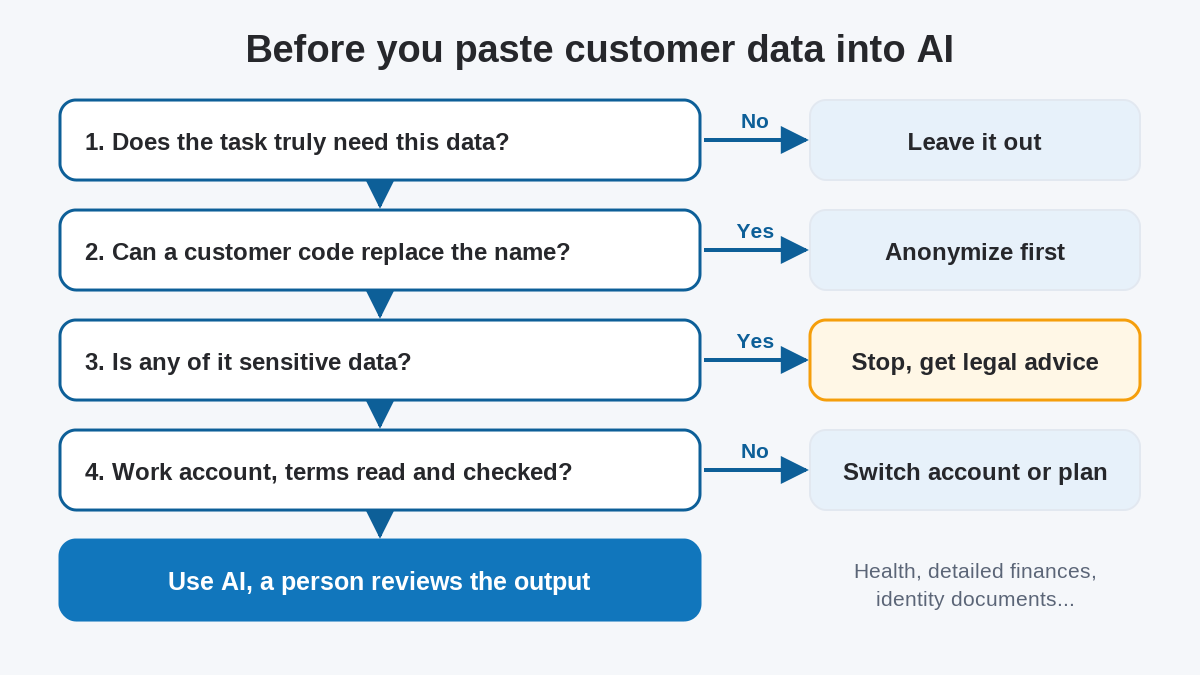
Make the four questions in Figure 2 a required step in the one-page guide from rule 7. A five-second pause before hitting "paste" is worth more than any ten-page policy that nobody ever opens.
Practice exercise
This is the last exercise in the series, and it is the one that helps you sleep better at night. Split it over two sessions if you like. When you are done, you will hold three things that plenty of larger companies still lack: a map of your customer data, a one-page AI guide and a set of metrics for next quarter.
- Build an "our customer data" table: for each data type (name, phone, email, purchase history...), note where it is stored, who can access it, what purpose it is collected for, and whether consent is recorded.
- Mark the data types you put (or plan to put) into AI tools. For each one, ask: is it truly needed? Can it be anonymized?
- Read the data policy of the AI tool your team uses and note three things: is data used for training, where is it stored, and who can delete it.
- Write the one-page guide following the "Rules for using AI safely" section and fix 3 metrics to track next quarter. Turn any legal uncertainty into questions to ask an adviser.
Six lessons, six exercises. You've stayed with us all the way to this line, and your sales team now has a foundation solid enough for any AI tool to stand on.
How Kingsley Asia can help
The three metrics, the five-step rollout and the one-page guide are things Kingsley Asia can draft with you at the right size for your team. For detailed legal questions on personal data, we connect you with a suitable specialist from our network rather than playing lawyer ourselves. Start with our Business strategy & operations page, or send us the list of questions the exercise above just helped you write down.
Sources
- LuatVietnam, Decree 356/2025/ND-CP detailing the Law on Personal Data Protection (2025)
- LuatVietnam, The Law on Personal Data Protection 2025, No. 91/2025/QH15 (2025)
- LuatVietnam, Comparison of the 2025 Law on Personal Data Protection and Decree 13/2023/ND-CP (2025)
- Official Gazette of Vietnam, Law No. 91/2025/QH15 on Personal Data Protection (2025)
- Official Gazette of Vietnam, Decree No. 356/2025/ND-CP (2025)
- EY Vietnam, Decree No. 356/2025/ND-CP detailing the Law on Personal Data Protection (2026)
- Government News (Báo Chính phủ), Administrative fines for personal data protection violations (in Vietnamese, 2026)
- OpenAI, Enterprise privacy at OpenAI (2026)