
Fifty business cards from a three-day trade fair, and your team has time to call ten of those people properly (illustrative). Which ten is what this lesson is about.
Two kinds of score: fit and engagement
Lead scoring means giving each prospect a number so the whole team knows whom to contact first, rather than calling whoever someone happens to remember. For a small business, the safest approach is to write a simple scoring frame yourself, and only then bring in AI to apply that frame across large volumes and to suggest where new prospects might be found. The raw material is the data from your minimum CRM in lesson 3 and the sales stages you mapped in lesson 2.
A seasoned real estate agent looks at every enquiry with two pairs of eyes. The first asks, "Does this person actually need, and can they afford, the apartment I'm selling?" The second asks, "Are they genuinely viewing homes, or just scrolling listings on a Sunday night?" Someone with the budget but no plans yet deserves patient follow-up, while someone wonderfully keen whose budget is miles off makes a smart agent think twice before giving up a whole afternoon of viewings.
CRM vendors' documentation splits lead scores into exactly those two groups. Fit scores rest on identity information: industry, company size, the contact's job title, region. Engagement scores rest on behavior: opening emails, clicking links, visiting the pricing page, replying to messages, agreeing to a meeting. The split lets you answer two different questions: "Is this an ideal customer for us?" and "Do they want to buy right now?"
We suggest you resist merging the two into one number. A prospect who fits perfectly but has gone quiet needs nurturing with useful content. A prospect who keeps asking questions but sits outside the segment you serve well needs a clear decision on whether to pursue at all. Blend the scores together and that important difference simply disappears.
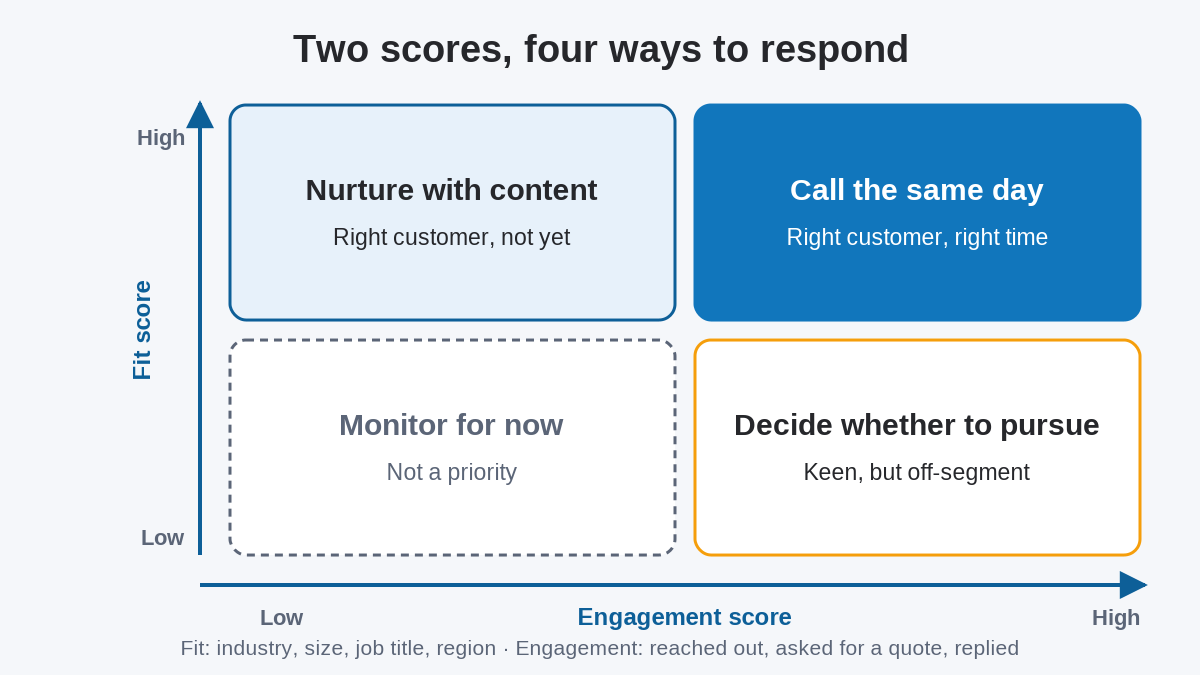
This afternoon, take the five prospects your team has been chasing hardest and drop each one into a box in the figure above. It takes about five minutes, and there is a fair chance you will spot one or two names that are getting far more love than they have earned.
Build a 100-point frame in four steps
Say "scoring frame" and many owners picture a spreadsheet tangled with formulas. In practice it is closer to how a seasoned home cook picks fish at the market: check the eyes, press the flesh, lift the gills. No textbook required, because the judgment came from hundreds of good buys and a few regrettable ones. Your scoring frame should come from the same place, your own team's wins and losses.
- Look back at your wins. Take your 10 most recent won and 10 most recent lost customers from the CRM and ask how they differ: industry, size, decision maker, or how they found you?
- Pick 4 to 5 fit criteria and 4 to 5 engagement criteria. Each one must be checkable from data you already hold, not from a hunch.
- Assign points. The maximum is 100: fit 50, engagement 50. More important criteria earn more points.
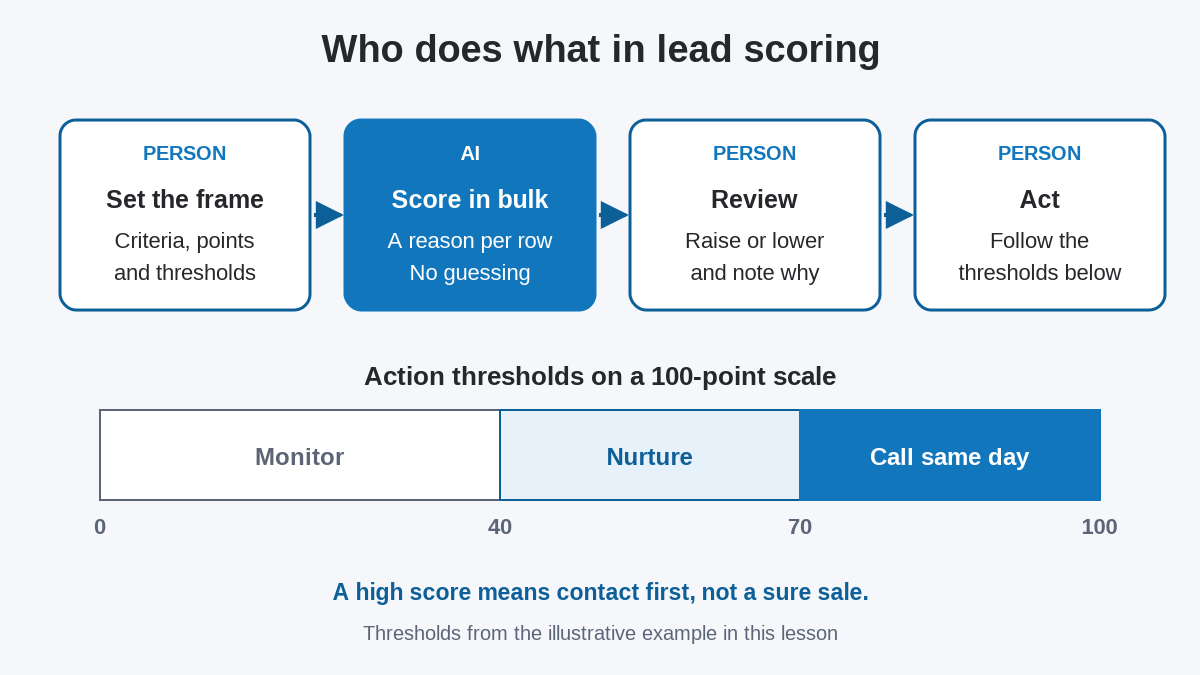
- Set action thresholds. For example, 70 and above: call the same day; 40 to 69: nurture with content; below 40: monitor for now.
Hanh runs a 12-person accounting services firm in Can Tho keeping the books for small businesses (illustrative). After one afternoon reviewing 20 past contracts, she writes this frame:
| Group | Criterion | Points |
|---|---|---|
| Fit | Company of 10 to 100 staff | 15 |
| Fit | Services or trading industry | 10 |
| Fit | Contact is owner or chief accountant | 15 |
| Fit | Based in an area the team can serve | 10 |
| Engagement | Reached out first | 20 |
| Engagement | Asked for price or a quote | 15 |
| Engagement | Replied to a message within 48 hours | 10 |
| Engagement | No response for over 30 days | -10 |
The negative row at the bottom is the one most people forget, and it earns its place. A prospect who goes quiet has to slide down the list; otherwise the "hot" list keeps growing like a fridge after the holidays that nobody dares to clear out. HubSpot describes a similar mechanism in its documentation: scores can add or subtract points, and there are caps so one group of criteria does not dominate the rest. Whatever tool you use, write the frame yourself first and do not let the tool decide for you.
A score never closed a sale. It only tells you which door to knock on first.
Version one of your frame needs one afternoon, as Hanh's did, and it does not need to be perfect. It only has to beat the memory of a busy person, which is not a high bar.
Where AI genuinely helps
Deciding what makes a good customer for your business is not a job for AI. Treat it as a tireless assistant who reads fast and never gets bored, but has never shared a coffee with a single one of your clients. That assistant earns its keep in four places:
- Enriching information: AI reads a company's website, news or public profile to fill industry, size and main products into the CRM. Someone on the team checks a sample before anyone trusts it.
- Bulk scoring against your frame: you paste the frame and a list of prospects (personal details removed) into the tool and ask for a score table with a reason on every row.
- Sorting inbound messages: AI tags messages as "price question", "support question", "spam" or "partner" so each lands with the right person.
- Suggesting where to look: AI proposes groups of companies similar to your wins so you can check them yourself. Finding and contacting people still happens through lawful sources, and that part stays with you.
Some CRM products include machine-learning scoring based on deal history. It needs enough won and lost deals to learn from, the way a new craftsman needs enough jobs under the belt before the skill sticks. So for a business just starting out, a self-written frame is usually the more practical choice.
A sample prompt to score against your frame
How you brief the AI decides most of the quality you get back. Here is a prompt (the text you type to tell the AI what to do) that Hanh could use today; just swap in a description of your own business:
You are a sales support assistant for an accounting services firm that serves small businesses.
Below is a lead scoring frame and a list of prospects (personal data removed; each prospect has only a code such as KH-014).
For each prospect:
(1) calculate the fit score and the engagement score strictly using the frame,
(2) give a short reason for each criterion applied,
(3) if information is missing, write "insufficient data" and do not guess.
Return a table with: prospect code, fit score, engagement score, total, reasons.
[Paste frame]
[Paste list]
That "do not guess" line matters more than it looks. Without it, AI may fill every gap just to complete the table, like a student who would rather write anything than leave a blank on the exam. The table looks wonderfully complete; whether it is right is another story.
When scores start to mislead
Shiny new tools have a habit of winning the whole team over in month one, only for nobody to trust their numbers by month three. These four points keep your scoring frame from going the same way.
- Bias from old data: if you have only ever sold to one type of customer, the frame will dismiss everyone else. Keep some time aside to test new segments.
- A score is not the truth: a high score means contact this one first, not that they will buy.
- Personal data: do not put customers' phone numbers, emails or addresses into an AI tool unless it is truly needed and you understand how the provider handles data. We cover this properly in lesson 6.
- People have the last word: a rep may raise or lower a score based on real-world information, as long as they note why. Those notes are exactly the data you will use to improve the frame later.
To see where the frame fits in the wider funnel, have a look at our article on the B2B sales funnel.
Practice exercise
Give this one or two working sessions. We think it is the best investment in the whole series, because at the end your team will share one order of priority instead of carrying a different list in every head.
- Take 10 won and 10 lost customers from your CRM and write down 3 things the winners have in common.
- Write a 100-point frame with 4 to 5 fit criteria and 4 to 5 engagement criteria, plus an action threshold for each score band.
- Score 20 open prospects by hand. Then use the sample prompt to have AI score the same 20 (personal data removed) and compare the two tables. Which rows differ most, and why?
- Adjust the frame and record the version number. Your high-scoring group becomes the input for the follow-up content in lesson 5.
Bring the comparison table from step 3 to next week's sales meeting and you will have everything you need for a good discussion. One debate about real numbers beats ten debates about whether a prospect "feels promising".
How Kingsley Asia can help
First scoring frames tend to mirror the instincts of the best rep on the team. Kingsley Asia can go through your recent wins and losses with you, draw out an ideal customer profile and set rules for assigning prospects by score, so Monday's call list starts with the right names. That work belongs to our Sales & marketing excellence service; once you have the comparison table from step 3, bring it to us and we'll go through it together.