
Asking friends "would you buy this?" and hearing the whole family cheer isn't market research, because a polite compliment has never been the same thing as an order. Real research for an SME only has to answer three questions: who your customers are, what they buy today (where and why), and where you can be different. Done lean, it fits into two to four weeks, with no survey firm required.
Which decision is the research for?
The shopper who walks into the market with a list gets home faster and spends less than the one who drops by "to see what looks good." Research works the same way. Don't research just to "know more." Start from a concrete decision, such as:
- Should we launch a new product or service?
- Should we open another branch, or sell online?
- What price lets us compete?
- Which customer segment should we target first?
The U.S. Small Business Administration (SBA) frames market research as learning about your customers, and competitive analysis as finding how you stand apart; the two work best together. From that, we draw one rule that works at any size:
If there's no decision to make, there's nothing to research yet.
So which decision are you most torn about this quarter? Write it down as one sentence, and that sentence will steer everything that follows.
Two families of research methods
Secondary research is like studying the map before a long road trip: you learn which roads are big and which towns are busy. Primary research is like pulling over to ask a local, who knows which stretch is under repair and where the good food is. A smooth trip usually needs both.
| Secondary research | Primary research | |
|---|---|---|
| What it is | Using existing data and reports | Collecting data yourself |
| Examples | Statistics, industry reports, search trends, competitor websites | Interviews, surveys, observation, trial sales |
| Cost | Low | Low to medium |
| Used for | Big picture, market size, trends | Behavior, reasons to buy, unmet needs |
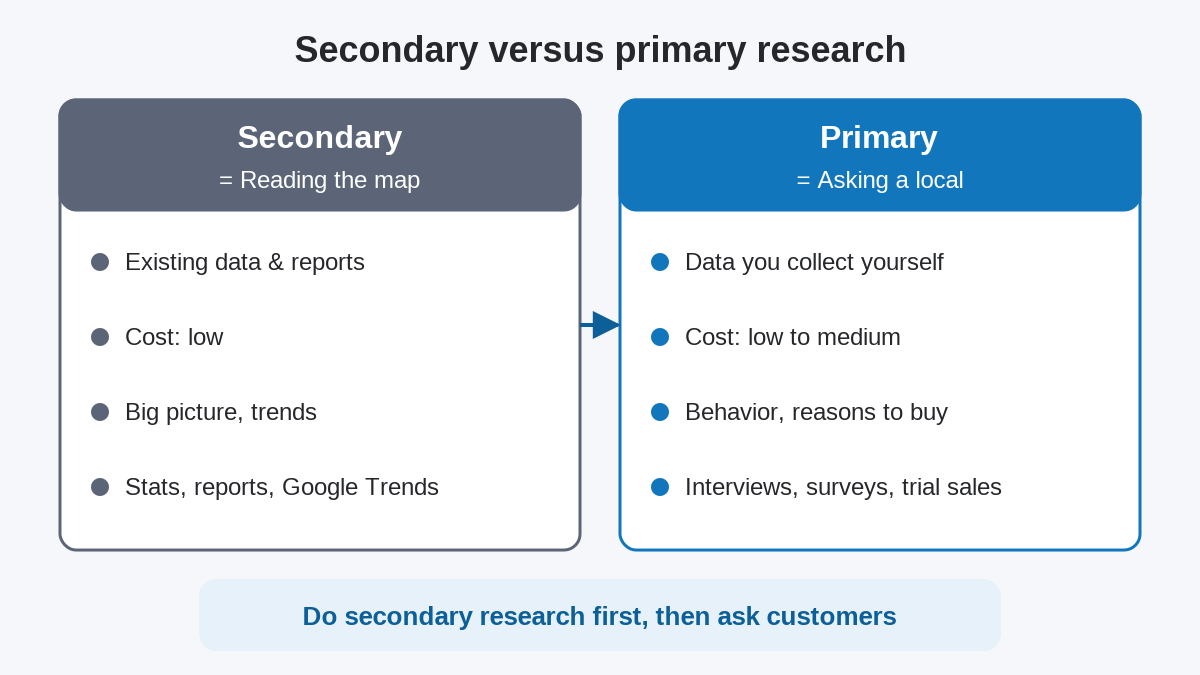
The SBA makes the same split: surveys and focus groups are primary research, while reports and industry data are secondary. Our advice is to do the secondary work first, so you don't spend precious interview time asking customers things you could have looked up yourself.
Five steps to market research on a small budget
The five steps run in order, and most small companies can finish them in roughly two to four weeks.
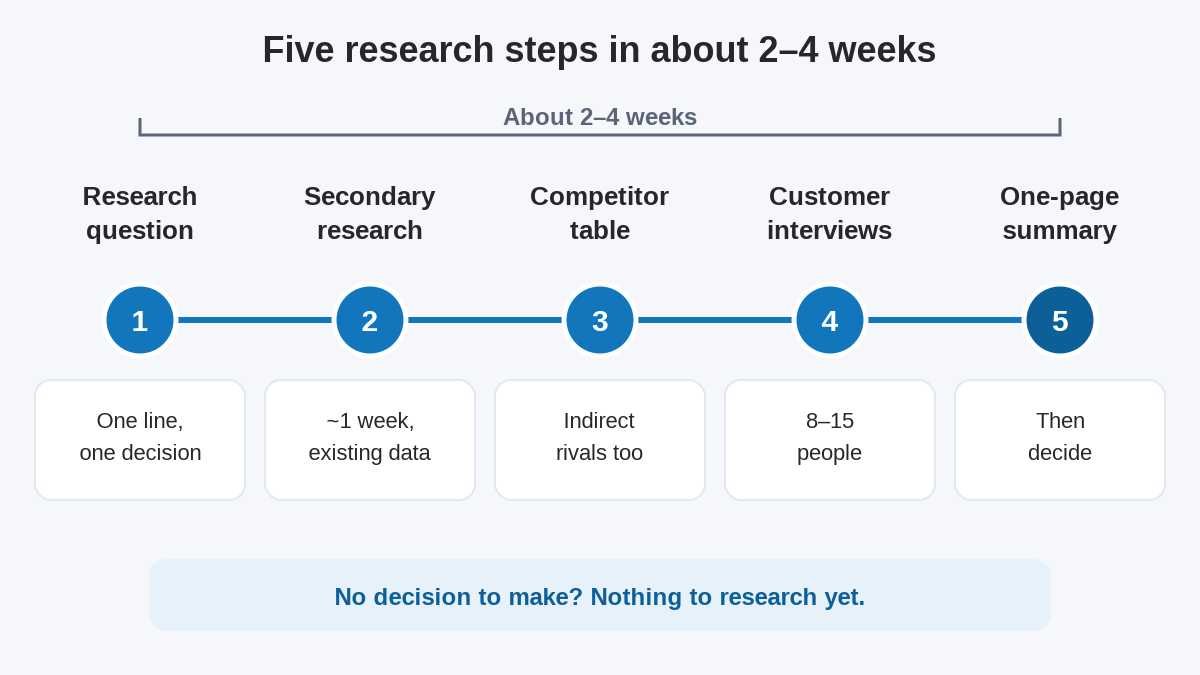
Step 1. Write your research question in one line
For example: "Are retail shops in Ho Chi Minh City willing to pay a monthly fee for inventory software, and what do they use today?" (illustrative). The sharper the question, the less effort you'll waste later.
Step 2. Secondary research (about one week)
There are plenty of free or low-cost sources you can tap right away:
- Macro and business data: Vietnam's National Statistics Office (NSO) publishes data and publications such as the Vietnam Enterprise White Book, which help you picture the size and makeup of businesses by sector and province.
- Search trends: Google Trends shows how search demand for a keyword shifts over time and by region, and Think with Google publishes Vietnamese consumer trend reports. Do check each report's year, because trends move fast.
- Industry associations and chambers: VCCI and sector associations often publish surveys and papers on small and medium businesses.
- Competitors: Study their websites, social pages and public price lists, plus customer reviews on marketplaces and Google Maps.
For every figure you use, note the source and the year, so that anyone who asks later can verify it.
Step 3. Compare competitors in a simple table
You don't need fancy software. A table like this is enough to see the picture:
| Criteria | Your company | Competitor A | Competitor B |
|---|---|---|---|
| Main customer segment | |||
| Standout products/services | |||
| Price (public) | |||
| Sales channels | |||
| What customers praise | |||
| What customers complain about |
And don't forget indirect competitors: the alternatives customers rely on today, such as Excel, manual work or asking an acquaintance, are competition too. Quite often, the toughest rival for a shiny new inventory app is the paper notebook the shop owner has trusted for ten years.
Step 4. Primary research: talk to 8 to 15 customers
For an SME, in-depth interviews with 8 to 15 people in your target group often yield more insight than a shallow survey. (That's a practical rule of thumb, not a statistical standard.) Here are some questions you can borrow:
- When did you last buy or use [this type of product]? What happened?
- What options did you consider? Why did you choose the one you did?
- What frustrates you most about how you do it today?
- What did you pay, and how did that feel?
- Who made the final decision?
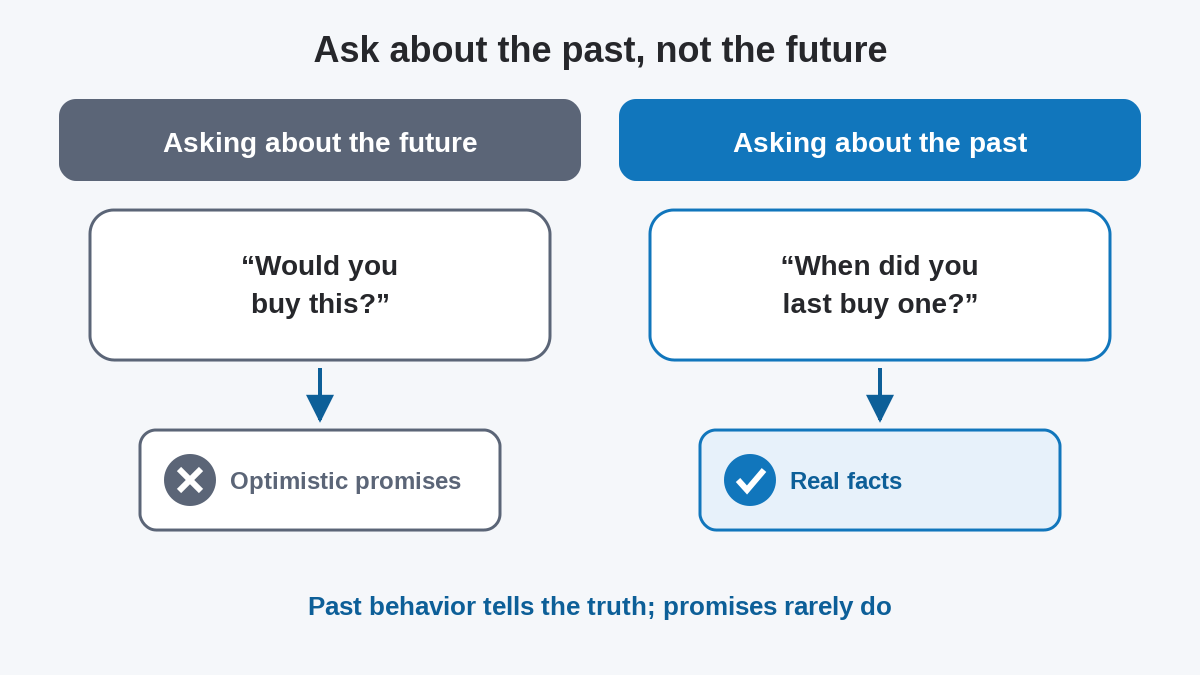
One small tip matters a lot: ask about real past behavior rather than "would you buy this?", because people tend to be optimistic about the future. Everyone promises to hit the gym in January; only the gym's check-in log tells the truth.
If you run an online survey, keep it under 10 questions and send it to the right group. You can also test demand with a simple landing page or a trial offer before committing to a big investment.
Step 5. Turn findings into a recommendation
Keep it to one page: the original question, three to five key findings (with sources), what remains uncertain, and the decision you propose. If the results call for more testing, design a small experiment rather than committing a large investment straight away.
The target for your first seven days is small: write the Step 1 question and book three people for Step 4. Those three conversations will usually teach you more than a week of reading reports.
Five ways research fools you
A survey can easily produce a pile of data that helps with no decision at all. The cause is usually one of these five.
- Asking only friends, and getting nothing but polite praise.
- Using old or unsourced data. Always note the year and the source.
- A skewed sample, such as surveying only your happiest customers.
- Confusing "lots of people are interested" with "lots of people will pay." Social media likes have never paid anyone's rent.
- Filing the report and forgetting it. Findings must lead to an action or a decision.
Putting the results to work
Your research feeds straight into brand positioning, your choice of sales channels and your business plan. Once you start selling, track customers in a simple system; you can read more in our article CRM for small businesses.
Your recommendation page, even in draft, only has to pass one test: "What will I do differently next Monday because of what I've learned?" If it passes, the research is already paying for itself.
How Kingsley Asia can help
Within a budget agreed up front, we help you sharpen the research question, find the right people to interview, and write the final recommendation so it leads straight to a decision. Questions that need deep sector knowledge go to a specialist who knows that market. You can see how we work on our Market Research & Business Planning page, or simply tell us which decision is keeping you up at night.
Sources
- U.S. Small Business Administration, Market research and competitive analysis
- National Statistics Office of Vietnam, Vietnam Enterprise White Book 2024
- Think with Google, Year in Search Vietnam 2022
- Digital in Asia, Marketing and Consumer Insight Tools from Google
- VCCI, Small and medium enterprises need support

Kingsley Asia
The Kingsley Asia consulting team – helping Vietnamese SMEs and international investors from strategy to execution.