
Three quick signs to check your business against:
- When a prospect asks "What makes you different?", your sales team answers with "great quality, fair prices, and we really care".
- Ask three of your people why customers choose you, and you get three different answers.
- Most of your recent deals ended in a round of haggling over price, even though your product holds its own.
Two or more of those, and your business probably doesn't own a distinct spot in the customer's mind yet, which means buyers are choosing you, or dropping you, mostly on price.
Brand positioning through a business owner's eyes
Brand positioning is the distinct place your business holds in your customers' minds: who you're for, what problem you solve, and how you differ from the alternatives. For a small or mid-sized company, it isn't a slogan or a logo. It's a deliberate decision about who you say yes to and, just as important, who you say no to.
Open the fridge in your kitchen. Every shelf has its job: eggs up top, leftovers in the middle, vegetables in the bottom drawer. When you want vegetables, you open the bottom drawer without a second thought. Your customers' minds work the same way. A brand with a clear shelf gets picked the moment it's needed. A brand tucked somewhere in the back tends to sit there, forgotten, until it quietly expires.
The idea was popularized by advertising executives Al Ries and Jack Trout, most notably in their 1981 book Positioning: The Battle for Your Mind. Their core point: people are flooded with messages, so they file each brand into a familiar mental category, and a brand that finds a clear, unoccupied slot is far easier to remember. As Wikipedia describes it, positioning is also one of the three steps of the segmentation, targeting and positioning (STP) model in marketing strategy.
At its simplest, positioning is your answer to "Why should a customer choose us over the others?", and that answer has to stay consistent everywhere customers meet you, from your website and company profile to the first words your salesperson says. Three things are often mistaken for positioning, so let's separate them right away:
- It isn't a slogan. A slogan is wording; positioning is the decision behind the wording.
- It isn't a logo or a color palette. Those are identity, the visible expression of your positioning.
- It isn't "best, cheapest, fastest". A claim every competitor can make doesn't help buyers tell you apart.
The three-people question from the top of this piece is the fastest test there is: if they give three different answers, your position currently exists only in your own head.
Why small businesses need clear positioning even more
Anyone shopping for a party on a modest budget learns the trick fast: you don't buy a little of everything. They pick a few star dishes and put the money there. Small companies work the same way. Resources are limited, so when you try to serve everyone, your message gets watered down and your sales team ends up explaining the business from scratch to every single prospect.
A guide from The Motley Fool, along with many small-business marketing resources, argues that the biggest benefit of positioning is focus: knowing which customers, channels and messages to prioritize. In fairness, that's a widely held view among practitioners rather than a measured result. Still, you can test it against your own sales experience, and most owners find it rings true.
Talk to everyone, and you'll usually find that no one is listening.
This week, pull up your ten best customers of the year and look for what they share: the same industry, the same size, the same headache. That common thread is often your first clue to where you belong.
Five steps to build your brand positioning
Building a position is a lot like having a suit tailored: a good tailor measures first, chooses the fabric next, and only then cuts and fits. These five steps follow the same order.
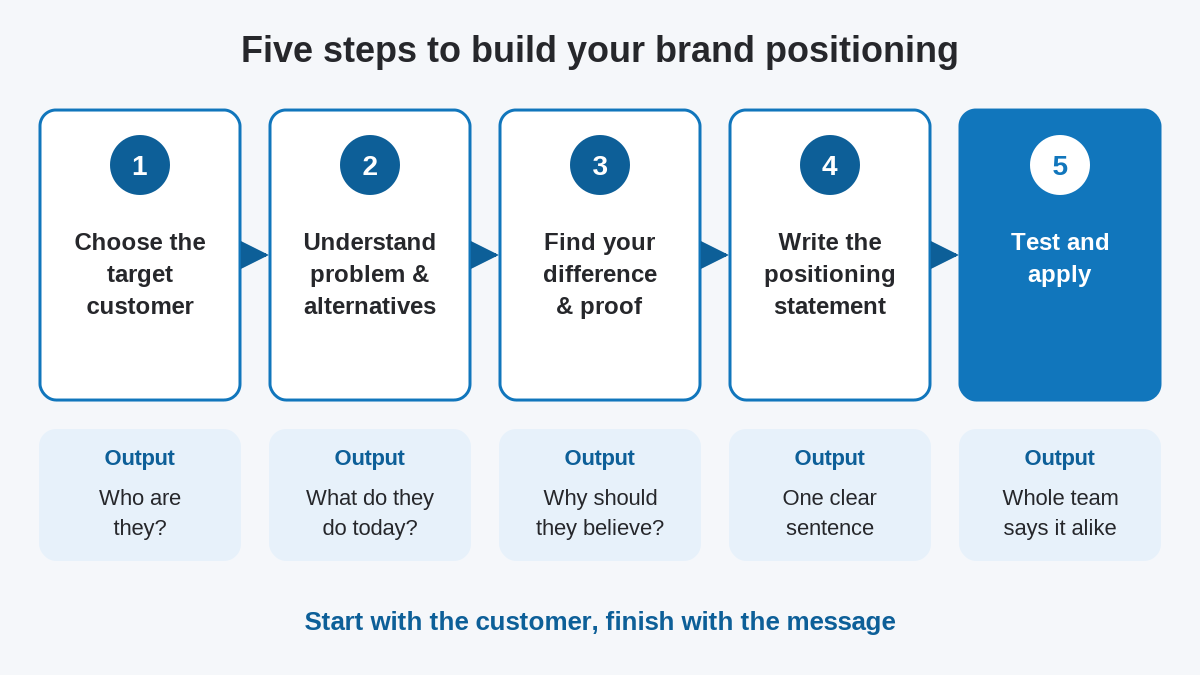
Step 1: Choose your target customer
Describe the group you most want to serve: their industry, their size, who makes the decision, and the situation they're in. For a B2B business, it might read like this: "manufacturers with 50–200 employees in southern Vietnam that still track orders in spreadsheets" (illustrative). The sharper the description, the easier every later step becomes.
Step 2: Understand the problem and the alternatives
Ask yourself: what are customers doing today to solve this problem? Your competition isn't only companies in your industry. It also includes doing it in-house, hiring someone else, or simply doing nothing. Have a conversation with five to ten current customers, plus a few prospects who said no, and you'll learn more than a month of guessing in the meeting room.
Step 3: Find your point of difference and your proof
Practitioner guides usually pair two ideas: a point of difference (the benefit only you deliver) and a reason to believe (the proof that it's real). TechCrunch adds a point worth remembering: buyers tend to check "points of parity" first, the basics any brand in the category must have, before they weigh the differences. So make sure you're solid on the basics before you lean on what makes you special. A restaurant with the most creative menu in town won't win many repeat guests if the plates aren't clean.
A quick, practical tool here is a perceptual map. Pick two axes customers genuinely care about, say price and level of customization, plot your competitors, and look for open space.
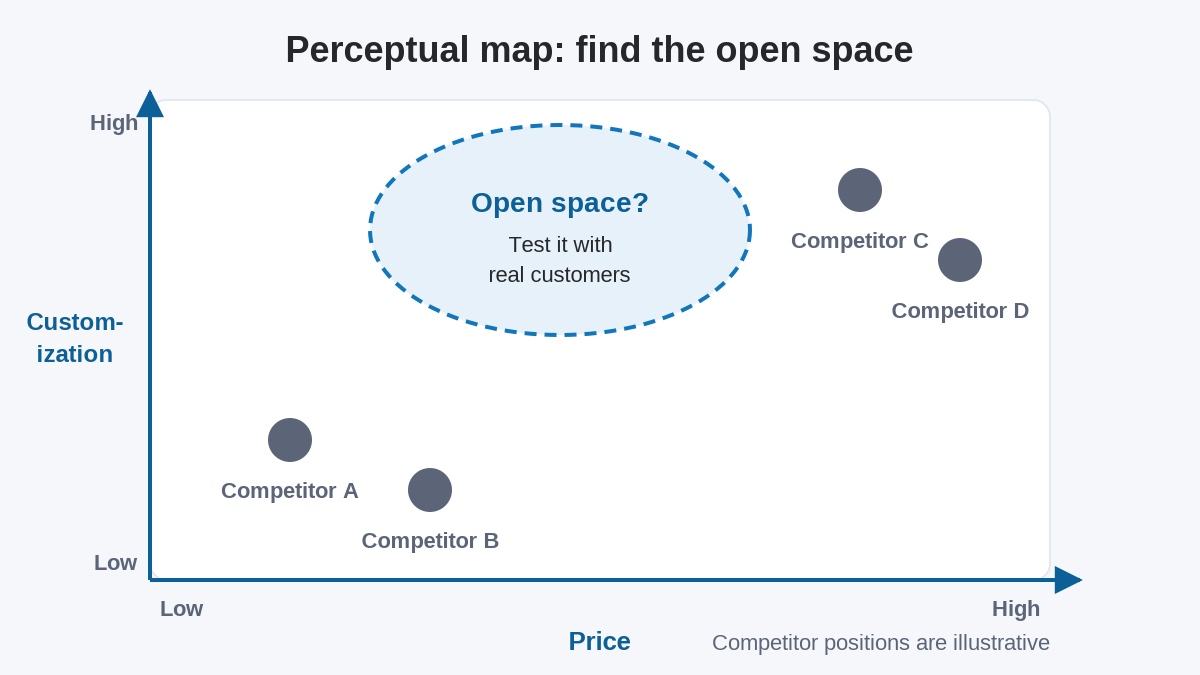
One word of advice: test those axes against real customer feedback rather than your own assumptions. An empty spot on the map can be a gold mine. Sometimes, though, it's empty because nobody actually wants to go there.
Step 4: Write the positioning statement
Now it's time to pull everything into one sentence. Use the fill-in template below. Treat it as an internal document that keeps the whole team aligned, not as copy to paste onto your website:
For [target customer] who [problem or need], [brand name] is a [category] that [main benefit]. Unlike [main alternative], we [point of difference], because [proof or reason to believe].
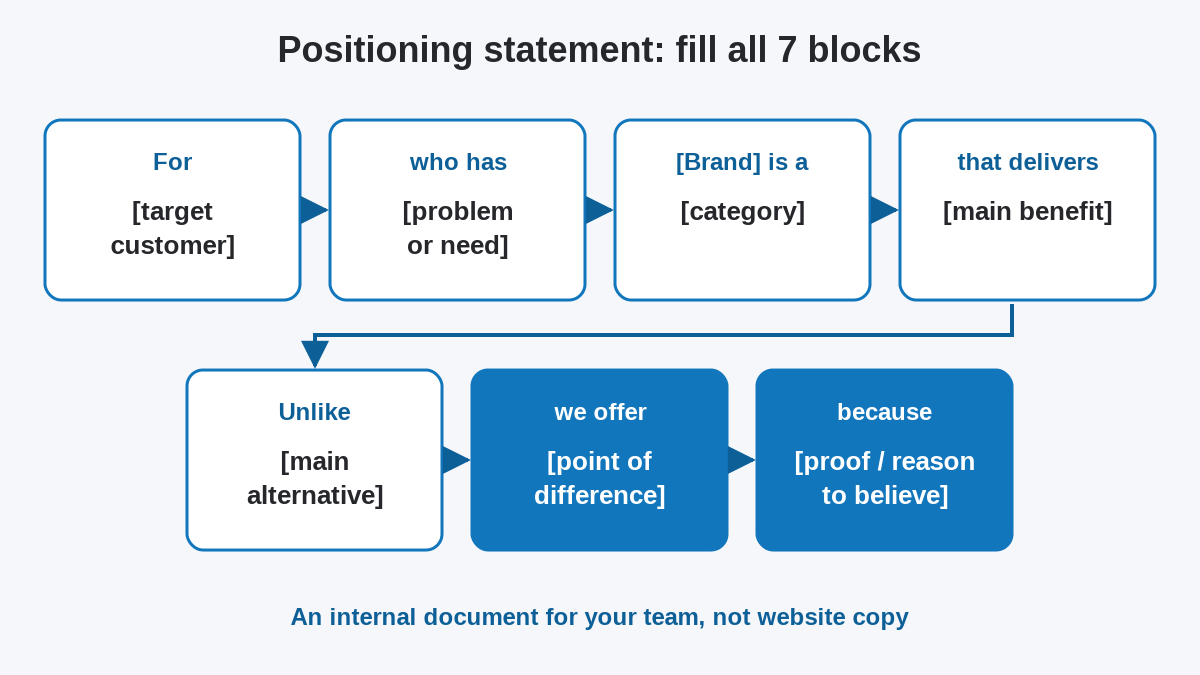
Company X is a small operations advisory firm (illustrative, not a description of any real business). After filling in the template, they land on this: "For small manufacturers who manage orders in spreadsheets, Company X is an operations advisory service that gives them a clear process in eight weeks. Unlike packaged software, we design the process first and pick tools second, because our team has run production operations directly." It doesn't sound poetic at all, and that's exactly why it works.
Step 5: Test and apply
Show the statement to a few customers and colleagues and ask them to say it back in their own words. If they get it wrong, it isn't clear enough yet. Once it holds up, turn it into concrete messages: your about page, sales scripts, company profile and, above all, the way your whole team answers "how are you different from the others?".
Step 1 plus three customer coffees booked for Step 2 is a perfectly respectable first week. Good positioning is usually written after conversations with customers, rarely during a three-hour internal meeting.
Positioning statement checklist
Nobody buys a used motorbike without walking round it, starting the engine and squeezing the brakes first. Your positioning statement deserves the same test ride, and five questions will do it.
| Question | Passes when |
|---|---|
| Is the target narrow enough? | You can name 10 companies that fit |
| Does the difference matter to customers? | Customers have mentioned it when choosing a supplier |
| Is there proof? | Verifiable experience, process, data or certification |
| Could a competitor say the same thing? | If yes, dig deeper |
| Does the whole team explain it the same way? | Ask three people; the answers are alike |
As soon as your first draft is done, run it through these five questions. Wherever it fails, go back to that specific step instead of rewriting everything from scratch.
Four places positioning comes off the rails
A positioning statement that nobody ever uses has usually come off the rails in one of these four places.
- Positioning around the owner's pride rather than the customer's need. What you're proud of isn't always what customers pay for.
- Promising too many benefits. Pick one main benefit; everything else plays a supporting role.
- Changing your positioning constantly. It needs time to settle in customers' minds, the way a song needs a few plays before it sticks.
- Saying one thing, operating another. If you promise "fast response" but quotes take a week, your positioning is just a poster on the wall.
Positioning isn't what you say. It's what customers remember about you.
Once you have a position, the next step is expressing it consistently through your name, visuals and voice. You can read more in Building a Company Brand: From Strategy to Identity.
How Kingsley Asia can help
A positioning project with Kingsley Asia usually opens with your list of ten best customers and closes with a statement the whole team nods at when it's read aloud. From there, we help rewrite the sales script, company profile and marketing plan around it, with a specialist from our network who has cracked similar problems before. The scope is on Brand Identity & Integrated Marketing; once you have those ten names in hand, arrange a meeting.
Sources
- Wikipedia – Positioning (marketing) (accessed 2026)
- TechCrunch – Carve out a place for your brand with a positioning statement (2021)
- Dummies – How to write a positioning statement for your brand (accessed 2026)
- The Motley Fool – How to leverage brand positioning for your small business (accessed 2026)
- Al Ries and Jack Trout, Positioning: The Battle for Your Mind (1981)

Kingsley Asia
The Kingsley Asia consulting team – helping Vietnamese SMEs and international investors from strategy to execution.