
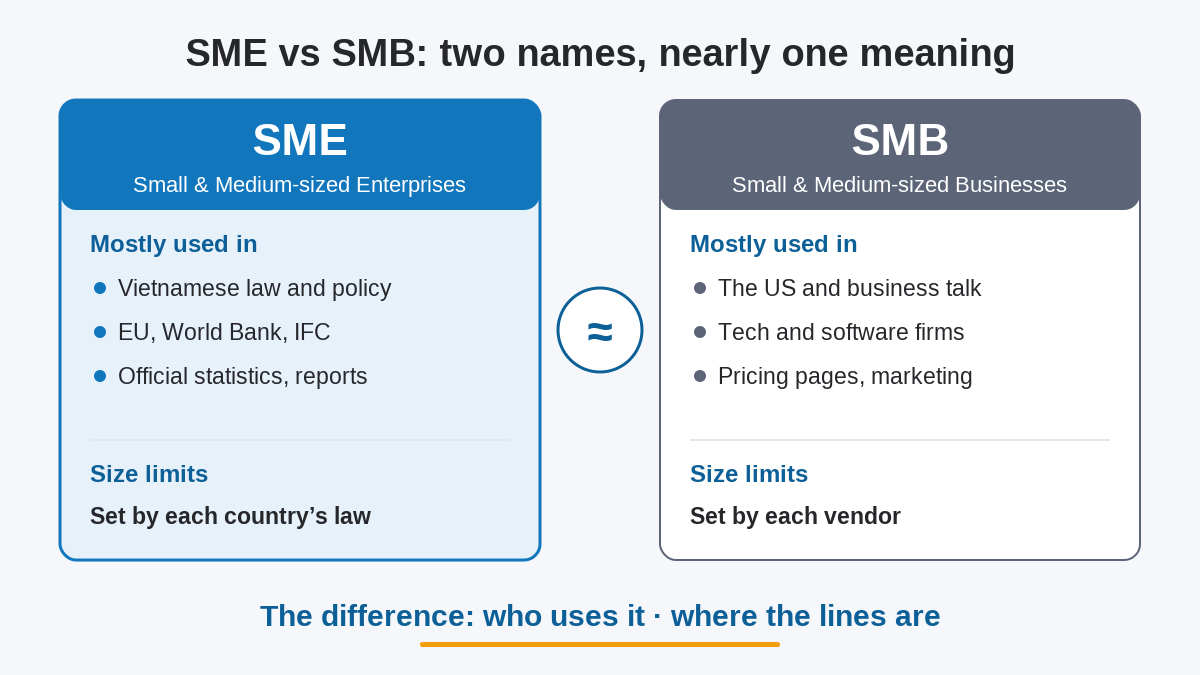
SME and SMB are two names for essentially the same group of companies. SME, small and medium-sized enterprises, is the language of governments, European Union rules and World Bank Group reports. SMB, small and medium-sized businesses, is what the business, tech and marketing world says, especially in the United States. Neither term contains the other, and neither excludes it. What differs is who's talking, and where they draw the size lines.
That sounds like a matter of vocabulary, but in Vietnam it has real money attached. A software vendor calling you an "SMB" is only picking a price plan for you, so the label hardly matters. Banks, the tax authority and public tender boards are another story: they use one definition only, the one in the Law on Support for SMEs and its implementing decree. Not knowing your tier, or ticking the wrong "company size" box on a form, can mean missing a tax break, a loan program or a preference in a tender.
Note: The legal information in this article is a summary based on the Kingsley Asia team's analysis of documents and sources published at the time of writing (11/2026). Policies may change; please confirm with a lawyer or accountant before acting on it.
Two names for the same group of companies
Order a "medium" coffee at two different chains and you'll see the problem. At one, a medium fits neatly in your hand; at the chain next door, the medium is nearly the size of the first shop's large. The letter M is identical, but the volume isn't. The "medium" in small and medium-sized enterprises works exactly the same way: everybody uses it, and everybody pours it into a different cup.
According to the European Commission's SME page (Recommendation 2003/361/EC), a medium-sized company in the EU has fewer than 250 staff, plus turnover of no more than €50 million or a balance sheet of no more than €43 million. The International Finance Corporation (IFC), part of the World Bank Group, puts medium enterprises at roughly 50 to 300 employees, with assets or sales of $3 million to $15 million, and a firm only needs to meet two of those three tests. In the US, people mostly just say "small business," and the Small Business Administration (SBA) doesn't use a single number at all: size standards are set industry by industry, based on employees or average annual receipts. In tech, "SMB" is looser still; a Salesforce blog post, for example, treats companies with 21 to 100 employees as "medium."
| Who defines it | Usual term | Upper limit for "medium" |
|---|---|---|
| Vietnam (Decree 80/2021/ND-CP) | Small and medium-sized enterprise | 100 or 200 insured employees, depending on sector |
| European Union | SME | Fewer than 250 staff |
| IFC (World Bank Group) | MSME, SME | Around 300 employees |
| United States (SBA) | Small business | Varies by industry; most manufacturers at 500 employees or fewer |
| Salesforce blog | SMB | 100 employees |
One detail in that table deserves a second look. Take a trading company with 150 insured employees. In Europe it's still a medium-sized enterprise; in Vietnam it has already stepped outside the legal SME group. A 2010 World Bank blog post by Khrystyna Kushnir argued that one universal definition for every country is neither practical nor really desirable. There is no global "medium" cup.
So the next time a software vendor pitches its "SMB plan," ask one question: "Is this priced by users, by orders or by revenue?" That answer tells you whether the plan fits your company. The label on it doesn't.
How Vietnam defines small and medium-sized enterprises
In boxing, every fighter steps on the scale before the bout. Nobody gets to call themselves a lightweight just because they're feeling light that day. Companies have a scale too, and in Vietnam it's written into law.
Under Article 4 of the Law on Support for Small and Medium-sized Enterprises No. 04/2017/QH14 (text published on LuatVietnam), SMEs include micro, small and medium enterprises with an annual average of no more than 200 employees enrolled in social insurance, and that also meet one of two tests: total capital of no more than VND 100 billion, or total revenue in the previous year of no more than VND 300 billion. The law splits companies into three sectors, and Article 5 of Decree 80/2021/ND-CP sets the thresholds for each tier, as shown below.
| Tier | Agriculture, forestry, fisheries; industry and construction | Trade and services |
|---|---|---|
| Micro | Up to 10 insured employees (annual average); and revenue up to VND 3 billion or total capital up to VND 3 billion | Up to 10 insured employees; and revenue up to VND 10 billion or total capital up to VND 3 billion |
| Small (not micro) | Up to 100 insured employees; and revenue up to VND 50 billion or total capital up to VND 20 billion | Up to 50 insured employees; and revenue up to VND 100 billion or total capital up to VND 50 billion |
| Medium (not micro or small) | Up to 200 insured employees; and revenue up to VND 200 billion or total capital up to VND 100 billion | Up to 100 insured employees; and revenue up to VND 300 billion or total capital up to VND 100 billion |
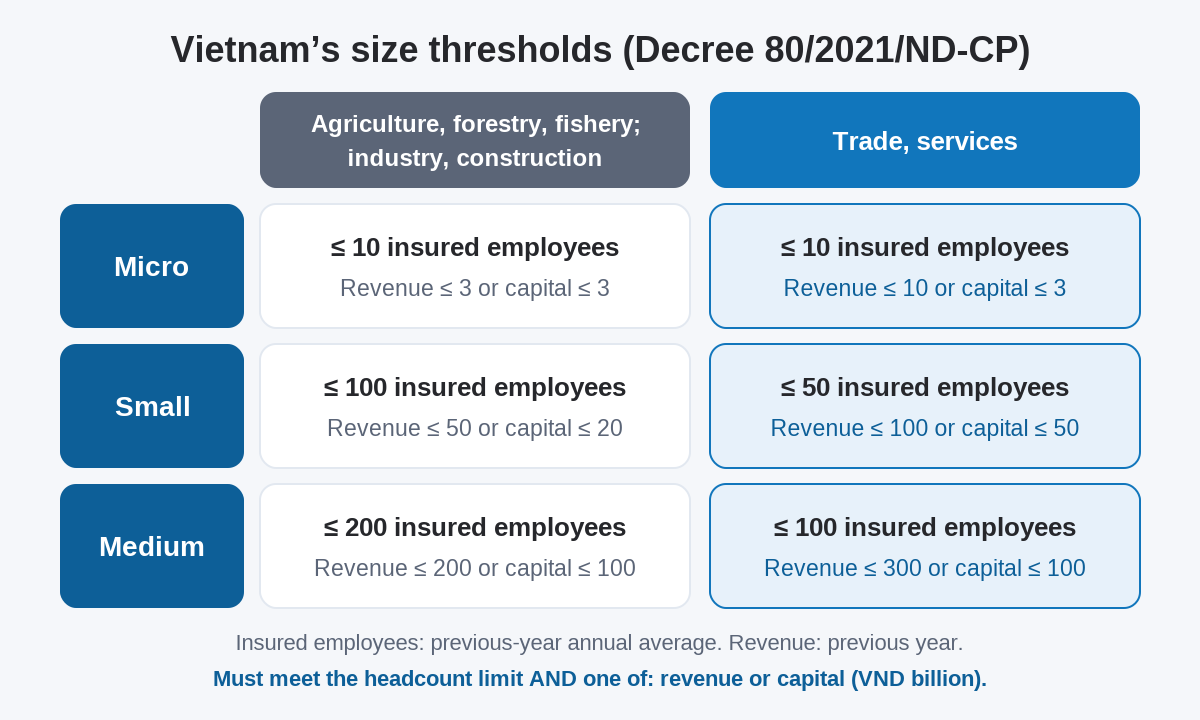
The numbers look clear enough, but the counting is where people slip. Under Articles 6 to 9 of Decree 80/2021/ND-CP:
- Sector is your main registered line of business.
- Employees means only people enrolled in social insurance. The annual average is the total of the 12 monthly counts for the previous year divided by 12; a company operating for less than a year divides by the number of months it has operated.
- Total capital comes from the balance sheet in the previous year's financial statements filed with the tax authority.
- Revenue is the previous year's revenue from sales and services, from the same filed statements. A company under a year old, or with no revenue yet, uses the capital test instead.
One important update. According to the Government's news portal, on 20/11/2026 the National Assembly passed the Law on Development of Small and Medium-sized Enterprises, taking effect on 01/7/2027 as a comprehensive overhaul of the 2017 law. At the time of writing, official reports hadn't published the new thresholds, and many details will be set by a new implementing decree. Until the new law takes effect, the table above remains your reference; after that date, check again.
This week, ask your accountant for just three numbers from the latest year: average insured headcount, revenue and total capital. That's your company's weigh-in.
Classify your company with three questions
With those three numbers in hand, the rest is like picking a size when you shop online: you measure yourself first, then read that brand's size chart, not some other brand's. The self-check takes three questions, in this order.
- What's your main line of business? That tells you which column to read.
- What's your average insured headcount for the year? Start from the micro row and stop at the first row where you're within the limit.
- Does last year's revenue, or your total capital, fall within at least one of that row's limits? If yes, that's your tier. If not, drop to the next row and check again.
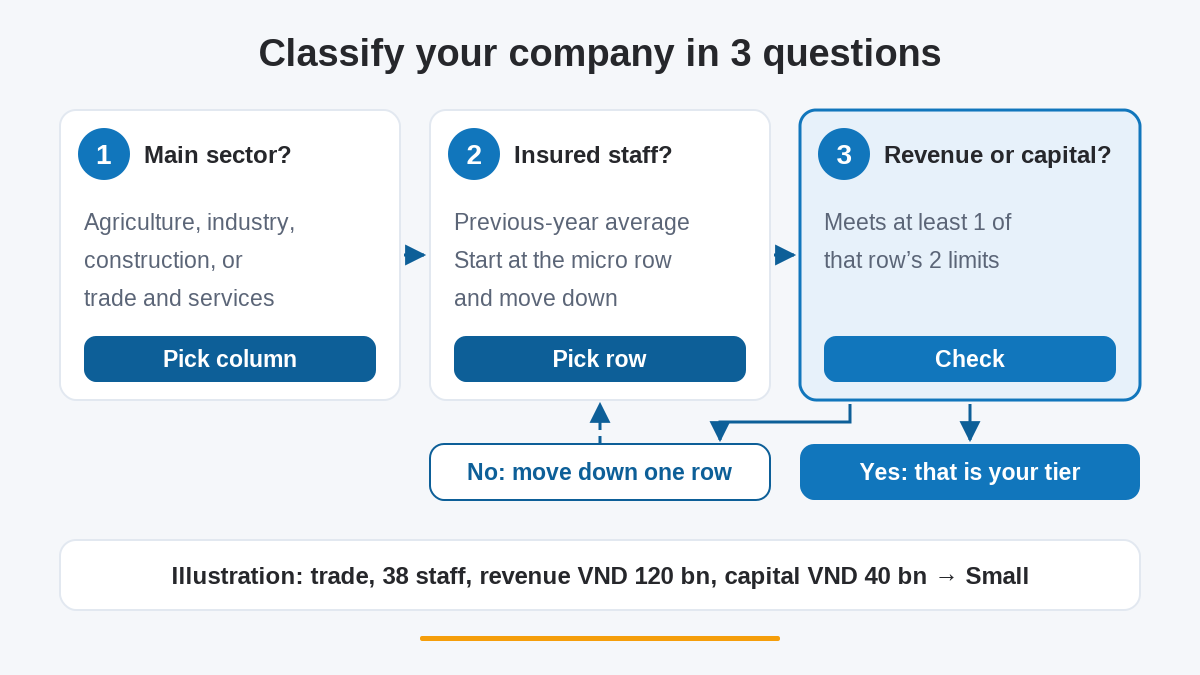
Ms. Thảo runs a cosmetics distributor in Cần Thơ (an illustrative example, not data from any real company). Her company averages 38 insured employees, booked VND 120 billion in revenue last year and has total capital of VND 40 billion. It's a trading business, so she reads the right-hand column. With 38 people she's above the micro limit but within the small limit of 50. Revenue of VND 120 billion overshoots that row's VND 100 billion cap, yet capital of VND 40 billion sits under the VND 50 billion cap, and the law only asks for one of the two. Result: a small enterprise.
One more common mix-up: the number on your timesheet isn't necessarily the number the law counts. Freelancers and seasonal workers who aren't enrolled in social insurance don't go into this calculation. When you run your own numbers through the three questions, write down the year of the data next to the result. Next year, your company may be in a different weight class.
Why knowing your tier matters
You've probably carried a supermarket loyalty card around in your wallet for a whole year without using it. The card exists, but if you never hand it over at the till, the points never land. Your company's size tier works the same way: once you've classified yourself correctly, you still have to go and claim the support.
Under the Law on Support for SMEs No. 04/2017/QH14, the main kinds of support are:
- Credit: the state encourages lenders to lend to SMEs, and SMEs may get guarantees from credit guarantee funds set up by provincial People's Committees (Articles 8 and 9).
- Tax and accounting: SMEs may apply a lower corporate income tax rate than normal for a limited time, as set out in tax law; micro enterprises get simplified tax procedures and accounting (Article 10).
- Production premises: provinces may subsidize rent in industrial parks and clusters for up to five years; this does not apply to companies with foreign or state capital (Article 11).
- Advice and training: SMEs can get free or reduced-cost advice through state-backed consultant networks, and reduced fees for state-funded courses on starting and managing a business (Articles 14 and 15).
- Public procurement: micro and small enterprises may receive preferential treatment in contractor selection under procurement law, with the exact benefit depending on the tender (Article 13).
On top of that, under Resolution 198/2025/QH15 (summarized on LuatVietnam), SMEs are exempt from corporate income tax for three years from the date of their first business registration certificate; the detailed conditions still depend on guidance from the Government and the tax authorities. Separately, the Corporate Income Tax Law No. 67/2025/QH15 sets rates of 15% and 17% for companies with prior-year revenue of up to VND 3 billion and from over VND 3 billion to VND 50 billion respectively; those rates depend on revenue, not on the SME label. Each commercial bank may have its own way of segmenting business customers, so when you're filling in that loan form, just ask the loan officer which program the "company size" box is used for.
Support doesn't come looking for you. You have to walk up and claim it.
When applying for support, companies are generally asked to self-declare their size on the form annexed to Decree 80/2021/ND-CP and are responsible for what they declare. One session with your accountant is enough to see where your company has actually "swiped the card," and where it hasn't yet.
Why Vietnamese say "các doanh nghiệp SME"
A little local color for international readers, plus a confession. In Vietnamese, people very often say "các doanh nghiệp SME," literally "SME businesses," and the Kingsley Asia team says it every day too. Strictly speaking, the E in SME already means enterprises, so the phrase comes out as "small and medium-sized enterprise enterprises." It's the same thing as saying "ATM machine" or "PIN number," and English speakers even have a cheeky name for the habit: "RAS syndrome," where RAS stands for redundant acronym syndrome. Yes, the name repeats itself too.
There's a rather charming reason Vietnamese speakers do it, though. Vietnamese likes to put a general noun in front so the listener knows straight away what kind of thing is being discussed: people say "sông Hồng" (the river Hồng) and "chợ Bến Thành" (Bến Thành market). Three bare letters in a Vietnamese sentence feel abrupt, like heading out on a motorbike without a helmet; adding "các doanh nghiệp" in front makes the sentence round and easy on the ear. And one more small twist: the law says "nhỏ và vừa" (small and medium), while most people in everyday speech say "vừa và nhỏ" (medium and small).
Our gentle suggestions on usage:
- In conversation, presentations and articles, the Vietnamese "các doanh nghiệp SME" is perfectly fine, and we use it ourselves.
- In loan applications, contracts and letters to government bodies, use the legal term "doanh nghiệp nhỏ và vừa," together with the tier: micro, small or medium.
- In English, "SMEs" is all you need; skip "SME enterprises" or "SME companies."
And if a Vietnamese partner says "SME businesses" in your next meeting, don't wince. You may well have just come back from the ATM machine yourself.
Five jobs for your next session with the accountant
Knowing where you stand is the first step to knowing what you can claim. Each of these five takes anywhere from a few minutes to one session with your accountant.
- Pull three numbers for the latest year: average insured headcount, revenue from sales and services, and total capital on the balance sheet.
- Check your business registration certificate for your main line of business, then pick the right column in the table.
- Run through the three questions in Figure 3, record your tier and the year of the data, and keep it with your company's legal files.
- If your company is newly registered, ask your accountant or tax office about the conditions for the three-year corporate income tax exemption under Resolution 198/2025/QH15; if you need funding, ask your bank and your province's credit guarantee fund (where one exists) about programs for SMEs.
- Set a phone reminder to recheck your tier every year after closing your financial statements, and once more when the Law on Development of SMEs takes effect on 01/7/2027.
If your company is growing fast and nearing the next tier, it's also a good moment to look at how you're organized. Have a read of our article Organizational Structure for Growing Companies.
How Kingsley Asia can help
Classifying your company is something you and your accountant can do with the tables above. Where we add more is the step after: reading your own numbers, working out which support programs may fit, and preparing the business and operating plan that makes your case to banks and partners clearer and more convincing. For in-depth tax and legal questions, we bring in lawyers and accountants from our expert network. This work sits within our Business Strategy & Operations service, and you're welcome to send us your specific case.
Sources
- Law on Support for Small and Medium-sized Enterprises No. 04/2017/QH14 – LuatVietnam (2017, accessed 11/2026)
- Decree 80/2021/ND-CP guiding the Law on Support for SMEs – LuatVietnam (2021, accessed 11/2026)
- Law on Development of SMEs takes effect 1/7/2027 – Vietnam Government Portal (2026)
- SMEs exempt from corporate income tax for 3 years (Resolution 198/2025/QH15) – LuatVietnam (2025)
- Corporate income tax rates under Law No. 67/2025/QH15 – LuatVietnam (2025)
- European Commission – SME definition (accessed 11/2026)
- IFC – Definitions of targeted sectors (MSME) (accessed 11/2026)
- U.S. Small Business Administration – Size standards (accessed 11/2026)
- World Bank Blogs – A Universal Definition of Small Enterprise: A Procrustean bed for SMEs? (2010)
- Salesforce – What's a Small and Medium-Sized Business (SMB)? (accessed 11/2026)

Kingsley Asia
The Kingsley Asia consulting team – helping Vietnamese SMEs and international investors from strategy to execution.