
Let's picture a familiar scene together. It's a bright Monday morning, you open the weekly report, and every number is green: revenue has hit target, orders went out on time, and customers have barely complained at all. And yet one question keeps nagging at you: "What will make this company different next year from this year?" Let us be straight with you: however good your KPI report looks, it can't answer that question. When a business wants to step into its next stage of growth, that's exactly when it needs OKRs.
Put simply, the difference between OKRs and KPIs comes down to purpose. A KPI (key performance indicator) tells you how well an activity is running. An OKR (objectives and key results), on the other hand, is the tool that moves your business toward a specific change within a set period of time. One doesn't replace the other. A small business usually needs a few KPIs to keep each department's daily rhythm steady, plus one or two OKRs to focus energy on the most important things this quarter.
OKRs and KPIs from a business owner's point of view
Slide into the driver's seat of the car you take out every day. KPIs are like the readings on the dashboard right in front of you: speed, fuel level, engine temperature. You glance at them to know whether your car is healthy or has a problem. An OKR, on the other hand, is the destination you type into the map before you pull away. These days plenty of cars have smart screens showing maps, a compass and your favorite playlist; but if you haven't entered a destination, even the fanciest screen can only tell you how fast you're going.
A KPI is a number that tells you how well a department or a person is doing against a goal that's already been set. According to Atlassian, a useful KPI needs a clear target and a specific timeframe. Think monthly revenue of 500 million dong, a repeat purchase rate of at least 40% each quarter, or every complaint resolved within 48 hours. Those are KPIs most business owners know well (the numbers here are illustrative).
An OKR has two parts. The first is an Objective, which says clearly what you want to achieve. Attached to it are about three measurable Key Results that tell you whether you've arrived. According to Google's public guidance (re:Work), OKRs trace back to Andy Grove at Intel. Google also recommends making OKRs public so everyone can see them, and picking only three to five objectives per cycle so the whole team's energy goes to the right place.
There's one small detail a lot of people miss: a key result has to be a result, not a task. "Call past customers" is a task. "70% of past customers place at least one more order this quarter" is a result. It might sound like nitpicking over words, but that small difference decides whether your team is simply busy or genuinely moving forward.
This afternoon, grab a sheet of paper and draw a line down the middle. On the left, write the numbers you track to know your company is "still healthy." On the right, write one thing you truly want the company to change in the next three months. The left column is your KPIs, and the right column is the first seed of an OKR.
Comparing OKRs and KPIs side by side
Now let's change into our kit, lace up our boots and head over to the football pitch for a moment. Here's one way to see it: KPIs are like the fitness numbers the coaching staff measure for every player each week, such as distance covered, heart rate and recovery time after a match; OKRs are like the goal for the whole season, say, winning promotion. And if you love the beautiful game, you'll know reality has shown time and again that a team in great physical shape doesn't always go up; a team in poor shape, however, almost never stands a chance, unless it's lucky enough to keep meeting teams in even worse shape.
Back at your desk, here is how the two tools look side by side.
| Criteria | KPI | OKR |
|---|---|---|
| Main purpose | Monitor the health of existing activities | Drive change and pursue new or ambitious goals |
| Question it answers | "How well are we doing?" | "Where do we want to go, and why?" |
| Cycle | Continuous, tracked weekly or monthly | Usually quarterly or yearly, reset each cycle |
| Level of ambition | Meet or beat the set target | Deliberately set high; per Google, around 60–70% counts as good |
| Scoring | Met / not met against the target | 0–1 scale for each key result |
| Typical scope | Departments, roles, individuals | Company and teams |
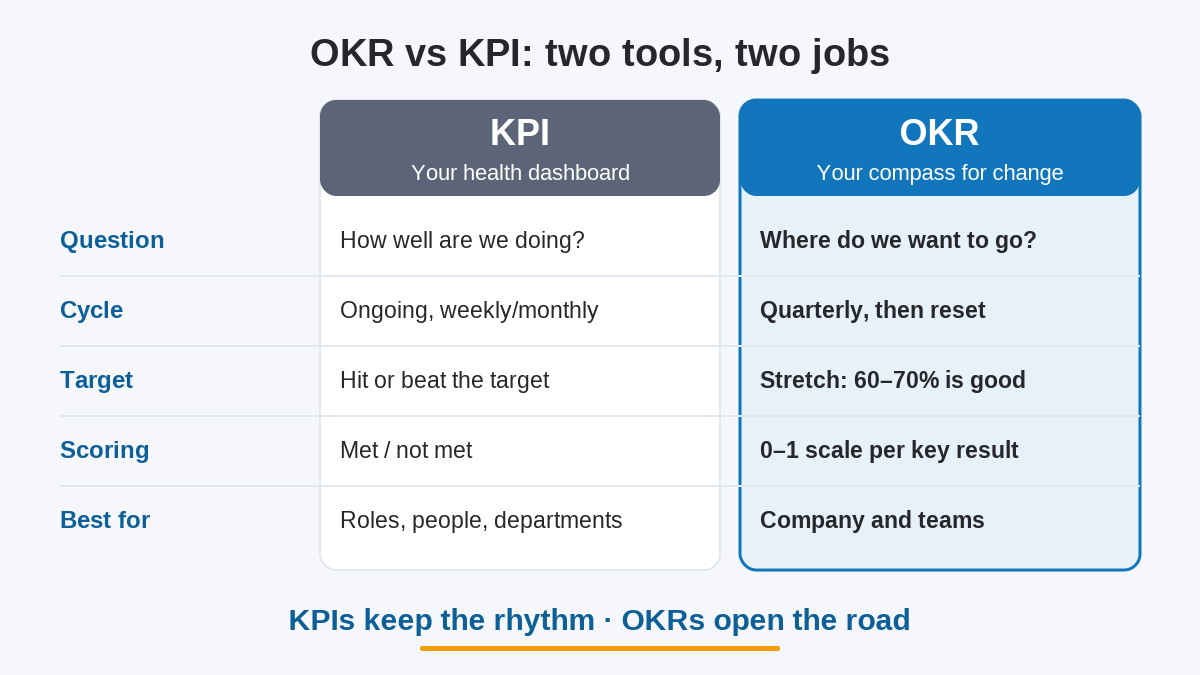
If you'd like one more way to remember it, WhatMatters offers a neat suggestion. WhatMatters is the organization associated with John Doerr, the person who brought OKRs to Google. According to WhatMatters, a KPI measures your current performance, while an OKR ties work to a purpose and comes with a process for the team to sit down together and review progress.
KPIs keep you steady. OKRs take you further.
The comparison is worth taking into your team meeting, along with just one question: "Of the numbers we track, which ones only need to hold steady, and which ones need a breakthrough?" More often than not, the answers sort themselves into two columns: one for KPIs and one for OKRs.
When to use KPIs and when to use OKRs
Anyone who has cooked the Lunar New Year feast for the whole family knows you don't shop for it with your everyday grocery list. Everyday meals need to be regular, nourishing and on time. The Tet feast needs a plan of its own, and it only happens a few times a year. Business works the same way: KPIs handle the "everyday meals," while OKRs handle the "feast" you want to get just right, the one the whole family will still be talking about by next Tet.
When KPIs are the right fit
- You already have a stable process and want to know whether it's still healthy, such as customer care or warehouse operations.
- You need to evaluate the work of a specific role. Atlassian suggests KPIs usually fit better at the individual level, because personal OKRs easily turn into a to-do list.
- You want an early warning light that tells you the moment a metric starts to slide.
When OKRs are the right fit
- Your company is heading in a new direction, such as entering a new market, launching a new product line or changing its sales model.
- You need the whole company to focus on a few of the most important things this quarter.
- You want departments pulling in the same direction, instead of each one polishing its own number.
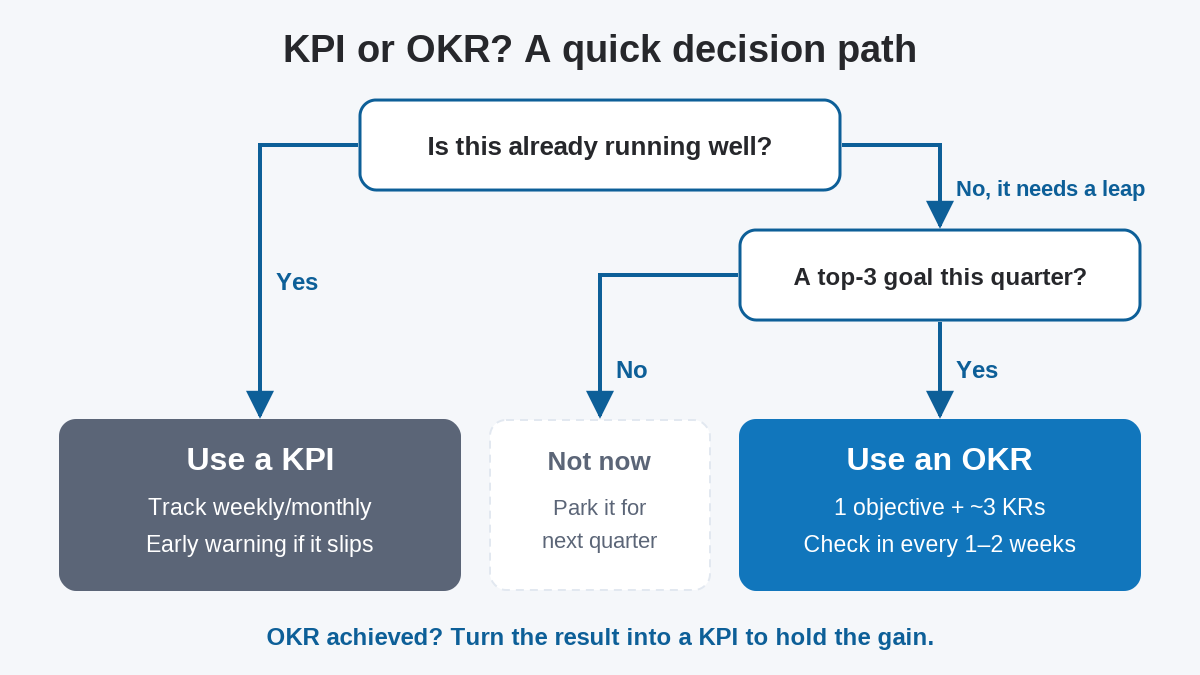
Ahead of the next quarterly meeting, run each goal through the diagram above one at a time. Any goal that lands in "Not now," go ahead and cross it off this quarter's list. Cutting back is a way of focusing too, much like a skilled chef who only needs a few truly great dishes for guests to remember the meal for years.
How to combine OKRs and KPIs in the same business
The garden tells the same story another way. Anyone who loves plants knows the rhythm of tending one: every week the gardener waters, feeds and turns over the leaves to check for pests so the plants stay healthy; that's your KPIs. When they want to graft a new variety for next season, though, they make a separate plan; that's your OKR. And any experienced gardener knows a graft only takes root on a plant that's already truly healthy.
According to WhatMatters, a KPI that needs a major change can become the foundation for an OKR. Once the OKR is achieved, that result can return to being a KPI you keep maintaining. Atlassian also notes that you can use a KPI itself as a key result. So the two tools aren't on opposing sides; they follow one another like two steps on a staircase.
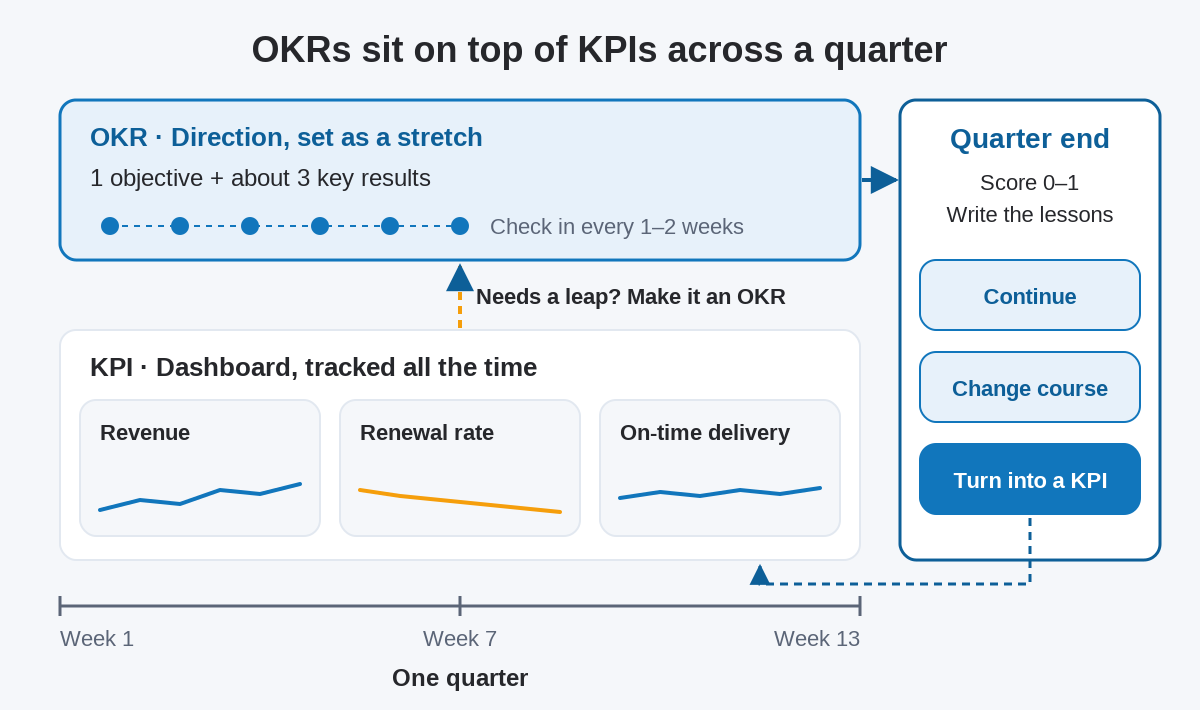
Take Lan, who owns a 25-person office equipment distributor in Da Nang (illustrative example, not data from any real business). Looking at her KPI dashboard, she sees that the contract renewal rate has fallen short of where she wants it for several quarters running. Instead of reminding the sales team one more time, she decides to make this number the company's OKR for the quarter.
- Existing KPI: quarterly contract renewal rate, with a target of 85%, but last quarter only reached 70%.
- This quarter's OKR:
- Objective: Our current customers keep choosing to work with us.
- KR1: Raise the contract renewal rate from 70% to 85% by the end of this quarter.
- KR2: Complete a value review meeting with 100% of priority customers within the first 6 weeks of the quarter.
- KR3: Cut response time to support requests from 24 hours to 4 business hours within this quarter.
- After the quarter: if the new process is running smoothly, Lan will keep tracking the renewal rate as an ordinary KPI.
KR2 deserves a closer look. Even with a number and a deadline attached, KR2 is still really a task, not a result. At this point Lan should ask herself: "Is this line measuring a result, or just measuring what we did?" A better version might be: "At least 80% of priority customers rate their satisfaction 4/5 or higher after the review meeting, this quarter." Google's guidance stresses exactly this point: a key result should describe a measurable change, not an activity.
Which number on your KPI dashboard has been "stuck" the longest? That is very likely the strongest candidate for next quarter's OKR.
Six steps to put OKRs and KPIs to work in a small or mid-sized business
Anyone who has laced up running shoes on an early January morning, full of resolve, knows this feeling: the person who eagerly runs ten kilometers on day one usually spends the whole next week letting their legs recover. Starting with OKRs is a lot like taking up running. That's why we recommend starting small, keeping a steady pace, and only then building up.
- Choose 3 to 5 core KPIs for the whole company, such as revenue, profit margin, customer retention or delivery performance, and set a monthly or quarterly target for each one.
- Each quarter, pick 1 to 3 of the most important objectives to turn into OKRs.
- For each objective, set about three measurable key results, each with a clear number and deadline.
- Share the OKRs with the whole team, then hold a short review meeting every week or every two weeks.
- At the end of the quarter, score them together as a team and write down what you learned. Google describes OKRs as not being a tool for performance evaluation, so please don't use OKR scores as the only basis for rewards or penalties.
- Finally, decide whether to continue, change course, or turn the result into a KPI.
This week, all you need to do is finish step 1 and put a review every two weeks into the calendar for the whole quarter. A meeting already sitting in everyone's phone will always beat ten promises of "let's sort it out next quarter."
Five things to watch so OKRs and KPIs actually stick
It's a familiar pattern: a company rolls out OKRs, everyone stays fired up for about three weeks, and then things slow down. The cause is usually one of the five bends below, and every one of them can be navigated as long as you know in advance where it is.
- Turning OKRs into a to-do list. If you can tick "done" and still can't say what changed, that's a task, not a result.
- Taking on too many objectives. Google recommends only 3 to 5 objectives per cycle. A team with ten priorities really has no priorities at all.
- Tying bonuses directly to stretch OKRs. When that happens, people usually set low targets to play it safe. Nobody in their right mind aims for the summit if one slip costs them their bonus.
- Having KPIs with no goals or actions attached. The bathroom scale has never helped anyone lose a single kilo. A metric tells you "where things stand," but improvement still comes from what your team actually does.
- Overlooking data quality. When the way you measure isn't reliable, both KPIs and OKRs easily turn into matters of opinion; and then the review meeting often becomes nothing more than a contest of who can talk loudest and promise best.
For anyone leading a sales team who wants to use these very measures to help people improve quarter after quarter, our article Sales Skills Training for B2B Teams is the natural next read.
How many of the goals pinned on your office wall survive those five points? Cross out even one line, and you've already lightened your team's load.
How Kingsley Asia can help
We can sit down with your leadership team and split your current metrics in two: the numbers that only need to hold steady become KPIs, and the one or two things that need a breakthrough become this quarter's OKRs, with key results that carry a real number and a deadline. Then we help keep the fortnightly review rhythm going until your team runs it on its own. Our Business Strategy & Operations page explains the approach; if you'd rather start from your own numbers, send us the KPI sheet you use today.
Sources
- Google re:Work – Set goals with OKRs (accessed 2026)
- WhatMatters – The difference between KPIs and OKRs (accessed 2026)
- Atlassian – OKR vs KPI (accessed 2026)

Kingsley Asia
The Kingsley Asia consulting team – helping Vietnamese SMEs and international investors from strategy to execution.