
The boss still signs every purchase request, right down to a box of pens. Two department heads spend a whole morning arguing over whose fault yesterday's late delivery was. A new hire, three weeks in, still doesn't know who to ask about anything. Customers who call in have to tell the same story to three different people. And you are at the office until 8 p.m., approving payments worth a few hundred thousand dong. The company now has 30, 50, maybe 100 people, yet everything still runs the way it did when eight or ten of you shared one room and an answer was never more than a turned head and five minutes away.
Those are the classic symptoms of growing pains, and most of the time the root cause isn't the people. Your organizational structure, meaning how the company divides work, hands out decision rights and sets who reports to whom, has simply become too small for the business. The cozy habits that once made you fast now clog things up: decisions slow down, work overlaps, and even your best people stop being sure what they actually own.
In fairness, this is a pain plenty of smaller companies would love to have.
Why the old structure stops working as you grow
There was nothing wrong with the school uniform your child wore in first grade. The fabric was still good. The child simply grew. Force it on another year and the buttons pop, and nobody blames the shirt. Structures work the same way: a setup that was perfectly sensible at ten people can feel painfully tight at fifty.
Professor Larry Greiner of the University of Southern California described this in a classic Harvard Business Review article. In Greiner's view, companies grow in stages, and each stage has a management style that works well; yet when that style hits its limits, it triggers a crisis that forces the company to change. The first stage usually runs on the founder's creativity and informal communication. As headcount grows, that's no longer enough: the company needs real managers, then delegation, then ways to coordinate across units. Greiner himself treats this as a reference framework, not a sequence every company follows in order.
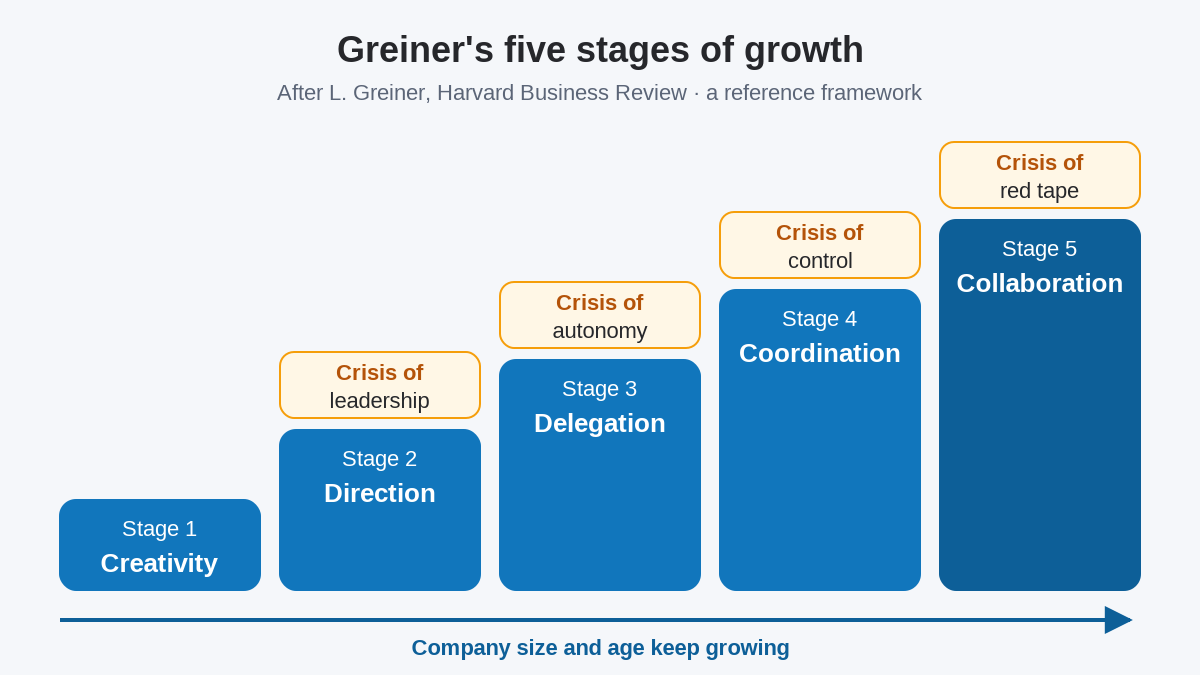
If you remember just one thing from this section, make it this:
Swap the people but keep the structure, and the same old problem will be knocking on your door in a few months.
Look back at the three incidents that frustrated you most recently and ask yourself: "Was that one person's mistake, or did nobody clearly own the job?" If the answer leans toward the second, your company's uniform may already be getting a bit tight.
Three common structure models
Busy restaurant kitchens show all three models more clearly than any textbook. In the first restaurant, the kitchen is split by skill: one person on prep, one on the hot line, one on desserts. That's a functional structure. When the owner opens more branches, each branch gets its own full kitchen with all three roles. That's a divisional structure. And in the restaurant that specializes in weddings, the pastry chef takes direction on technique from the head chef and on each event's menu from the banquet manager. That's a matrix. If those two managers don't agree, the pastry chef has the worst day, and the bride and groom get the worst cake.
Side by side, the three models compare like this.
| Model | How it is organized | Fits when | Typical weakness |
|---|---|---|---|
| Functional | By specialty: Sales, Operations, Finance, HR | Small company, few product lines, stable environment | Departments become silos; coordination is slow |
| Divisional (product, market, region) | Each unit holds the functions it needs to run itself | Several products, customer groups or branches | Duplicated resources; units drift apart |
| Matrix | Staff report to both a functional manager and a project or product manager | Project-based work needing deep expertise from several areas | Two bosses cause conflict; demands strong communication |
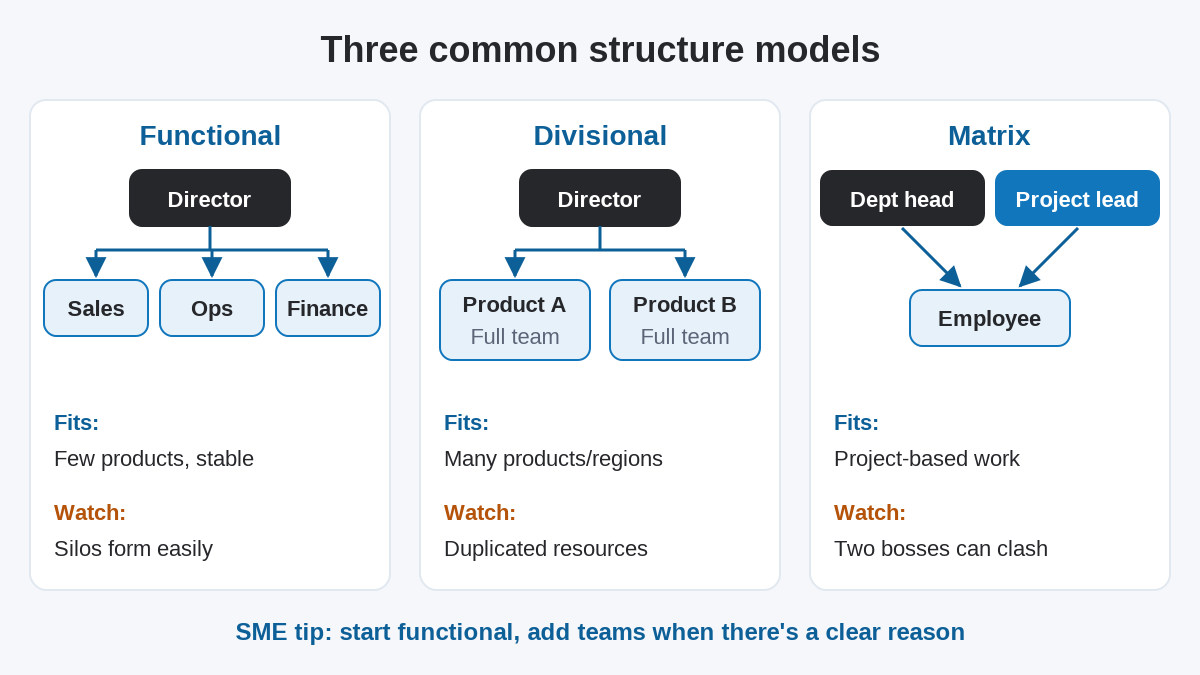
According to the OpenStax management textbook, the functional model offers deep specialization and scales easily while a company is small, but it invites silos between departments. The divisional model lets each unit respond quickly to its own customers. The matrix is flexible but hard to run, because every employee answers to two managers. Analyses of matrix organizations, including work by McKinsey, also show how often the model struggles in practice when clear rules are missing.
So what should a small or mid-sized business choose? In our view, most companies under a few hundred people do best starting with a functional structure and adding product or market teams only when there's a clear reason. Save the matrix for when your management discipline is already strong; otherwise it quickly becomes "two bosses handing out work, and neither one accountable."
A small exercise: pull out your current org chart (or sketch one on a sheet of paper if you don't have one) and mark which model you're closest to. The drawing alone surprises plenty of owners, who find someone reporting to three bosses at once.
Six warning signs it's time to rethink your structure
Nobody waits until something hurts to book an annual health check. The same goes for these six questions: answer them honestly and you'll know how healthy your company really is.
- Does every small decision wait for the owner or director to approve it?
- Do two departments regularly blame each other or duplicate each other's work?
- Does a new hire need weeks to figure out "who do I ask about this"?
- Are middle managers so busy with specialist work that they have no time left to manage people?
- Do customers have to explain the same issue to several different people?
- Are you the bottleneck, with every important matter passing through your hands?
Three or more "yes" answers are a fairly clear signal that it's time to redesign. Other management resources describe similar signals, such as specialists who don't share information with each other and departments that behave like silos.
This week, send these six questions to three to five key managers and ask each of them to answer separately, without comparing notes. Put the answers side by side and the bottleneck usually jumps out, sometimes more clearly than in a three-hour meeting.
Five design principles for a growing company
A good architect doesn't start by drawing a beautiful facade. They ask first: how many generations live here, who gets up early, who works from home, do you entertain often? The plan follows how the family lives, not the other way around. Structure works the same way, and these five principles help you draw it right from the start.
- Structure follows strategy. First decide how you compete: better prices, more attentive service or deeper expertise. Only then reach for the org chart. Draw the chart first and you're most likely just copying someone else's company.
- One accountable owner for every key task. A RACI chart (responsible, accountable, consulted, informed) saves you from "everyone cares, nobody acts." A job with two owners is usually a job with none.
- A sensible span of control. Each manager should lead only as many people as they genuinely have time to coach. There's no universal number; the more complex the work, the fewer people per manager.
- Delegate by limits. For example, a department head can approve spending under 20 million dong and escalates anything above that to the director (illustrative). The amount is yours to decide, as long as it's written down and everyone knows it.
- Separate "manager" from "excellent specialist." A brilliant salesperson isn't automatically a good team lead. Create a specialist career path alongside the management path, so great people can grow without being forced to become bosses.
Before your next leadership meeting, pick the three tasks that get bounced around most in your company and write one accountable name next to each. It's only three lines, but it settles at least three arguments before they even start.
Adjusting your structure in five controlled steps
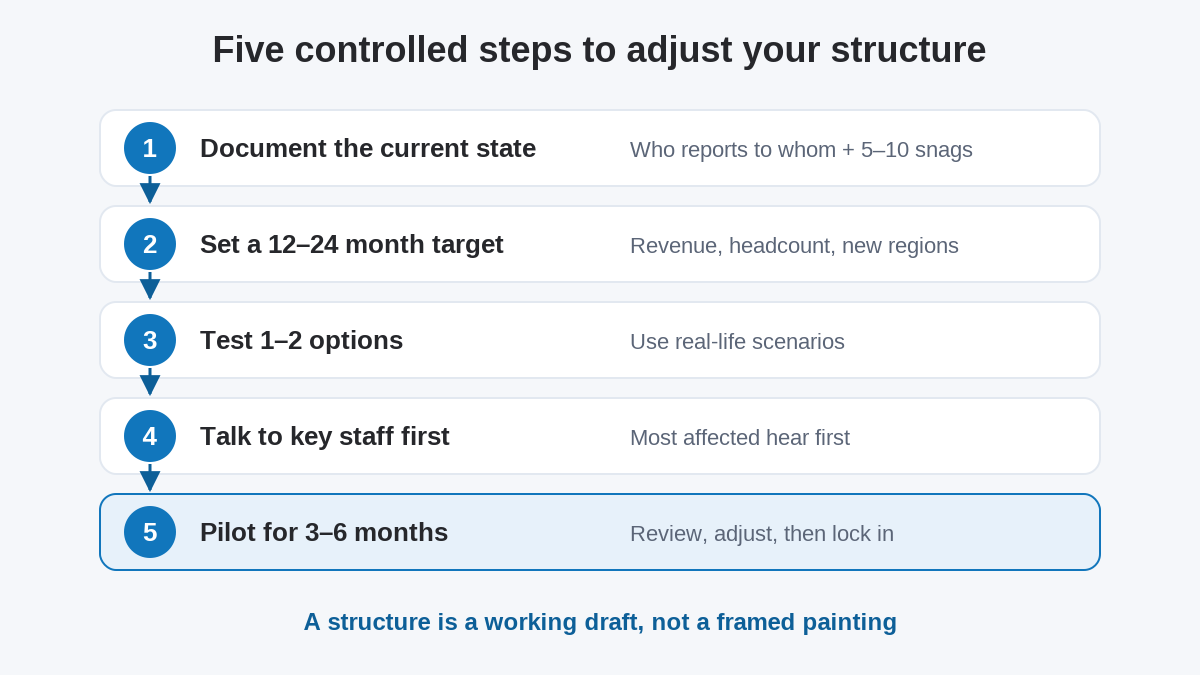
Changing structure while the company keeps running is like moving house while the family still has to eat, go to school and get to work every day. You can't dump all the furniture in the yard and figure it out later. You go room by room, with a list, a person in charge and a clear schedule. The five steps below are that list.
- Document the current state. Draw who reports to whom, then list 5 to 10 concrete friction points from the last three months.
- Set a 12 to 24 month target. Write down the revenue, headcount, new products or regions you expect over that period.
- Shortlist one or two options and test them on real situations. Ask concrete questions like: "If a customer complains, who handles it, and who can approve a refund?"
- Talk to key staff before you announce anything. The people most affected should hear first.
- Pilot for 3 to 6 months, review and adjust. A structure isn't a framed painting on the wall; treat it as a working draft that gets updated.
Hung owns a 45-person electrical supplies trading company in Ho Chi Minh City (illustrative example, not data from any real business). In step 1, he logs 8 friction points over 3 months, and 5 of them revolve around short deliveries where nobody has the authority to approve a return. In step 3, he tests a separate customer care unit whose head can approve returns under 20 million dong per order on their own. For the 3-month pilot, he sets a target of cutting complaint handling time from 5 days to 2, and he only locks in the new structure once that number is actually hit.
On the legal side, changing a person's job title, workplace or duties can touch their employment contract and the company's internal regulations. Under Article 33 of Vietnam's 2019 Labor Code (as published in the Official Gazette), a party wishing to amend an employment contract must notify the other at least three working days in advance. If both agree, the change is made through a contract annex or a new contract; if they do not, the existing contract continues to apply.
Note: The legal information in this article is a summary based on the Kingsley Asia team's analysis of documents and sources published at the time of writing (11/2026). Policies may change; please confirm with a lawyer or accountant before acting on it.
Today, open your calendar and block one day next month to do step 1 with two or three managers you trust. One afternoon spent redrawing the chart can save you a hundred afternoons of firefighting later.
Stones on the road to a new structure
Reorganized once and things barely improved? Don't lose heart. The usual culprit is one of these five stones, and every one of them can be spotted from a distance.
- Designing a chart that looks neat instead of clearing the real bottleneck that slows work down.
- Adding management layers too early. Information then works like a game of telephone: each layer bends the message a little, and by the bottom nobody recognizes the original.
- Making big changes in peak season, when the whole team is already running flat out.
- Forgetting to realign targets. You change the structure but keep measuring with the old ruler. Our article OKR vs KPI shows how to link goals to each role.
- Not writing down the new processes. A structure only runs smoothly alongside clear processes; see our piece on business process optimization.
Every stone you clear out of the plan now is one apology to the whole team you won't have to make next year.
How Kingsley Asia can help
We can walk the five steps above with you: logging the friction points, testing one or two options on real situations, writing the RACI chart and approval limits, and staying close through the pilot. Any change that touches employment contracts gets checked with a legal specialist at the start, not on announcement day. Read about our Business Strategy & Operations work, or tell us about the bottleneck that's wearing you out.
Sources
- Larry E. Greiner, "Evolution and Revolution as Organizations Grow", Harvard Business Review (1998, updated from the 1972 article)
- OpenStax, Principles of Management – Organizational designs and structures (2019)
- Mind Tools, The Greiner Curve
- Changing Minds, Greiner model
- Virginia Tech Libraries, Strategic Management – Creating an organizational structure
- McKinsey Quarterly, Beyond the matrix organization
- Vietnam Official Gazette – Labor Code No. 45/2019/QH14, Article 33 (2019)

Kingsley Asia
The Kingsley Asia consulting team – helping Vietnamese SMEs and international investors from strategy to execution.