
"That course was great, but I rang a customer this morning and heard myself saying exactly what I always say."
"Did you try any of the techniques on a real customer after the session?"
"Not yet. I've been chasing quotes all week."
That Monday-morning exchange between a new rep and her team lead (illustrative) explains most of why sales training so often leaves nothing behind but a nice binder on the desk. The workshop went fine. What was missing was anyone, or any time slot, between the classroom and the next sales call. Training only counts if people handle customers differently the week after. In B2B, that usually takes four things: a clear goal, content built around real work, repeated practice, and managers who coach on the job.
So over the next 90 days, who in your company is going to ask that second question, every single week?
Why most sales training leaves no trace
Summer crash swimming courses show the pattern well. After five lessons you can swim; skip the pool for a year, and next summer you're starting over. Sales skills work the same way. Training providers such as Highspot and Salesforce point to the same cause: a one-off session fades quickly without repeated practice and feedback afterwards. These are vendors with a commercial interest, so treat the point as a design hint rather than a guaranteed statistic.
Three mistakes show up often in smaller companies:
- Starting with content instead of a problem. The company buys a "closing skills" course when the real issue is that there are too few prospects to close.
- One program for everyone. A new hire and a veteran with five years in the field need very different things.
- Nobody coaches afterwards. Managers are busy chasing targets, so putting the lessons into practice is left to chance.
A great session creates inspiration. Only steady practice creates habits.
When was your company's last sales training? And since that day, have you seen anyone do one specific thing differently?
Step 1: Name the problem and how you will measure it
Salesforce advises starting from the specific problem the training must solve, then measuring results against that goal. The Kirkpatrick model of training evaluation follows the same logic: begin with the business result you want, then work back to the behaviors that must change. Diagnose the illness before you choose the medicine.
This table is an illustrative example of linking a problem to a metric:
| Visible problem | Behavior to change | Metric to track |
|---|---|---|
| Prospects say "let me think about it" and go quiet | Probe needs and decision-makers more thoroughly in the first meeting | Share of first meetings that move to a proposal |
| Quotes get pushed down on price | Present value before price | Average discount, win rate |
| New hires take too long to close a first deal | Learn a standard process | Days from start date to first deal |
Consider Mai, who owns a packaging company in Long An with ten salespeople (an illustrative example). Instead of a vague goal like "a better sales team," she picks the problem in the first row and sets a target: raise the share of first meetings that move to a proposal from 20% to 35% within 90 days (illustrative figures). With a number and a deadline, on day 90 she'll know for certain whether the training was worth the money.
Choosing metrics and setting targets is a topic of its own; our article on OKR vs KPI helps you tell the measures you track continuously from the goals meant to drive change.
Step 2: Pick core skills that follow your sales process
Don't try to teach "everything about selling." A good football coach doesn't run the whole squad through every drill in the book; they pick the drills that fix last weekend's weaknesses. Sales training should follow the steps your team actually goes through with customers. Highspot suggests a foundation of discovery, qualification, objection handling, stakeholder mapping and follow-through. For B2B, you can group these into five blocks:
- Preparation and research: learn the company, the industry and the contact before the meeting.
- Discovery: ask open questions, listen, and summarize back so the customer can confirm.
- Value presentation and proposal: tie your solution to the customer's goals instead of listing features.
- Objections and negotiation: tell a real objection from a polite no.
- Follow-through and next step: every meeting ends with a specific action and a date.
You can adopt an established method such as SPIN or MEDDIC to give the team a shared vocabulary. What matters isn't the brand name; it's that everyone labels deal stages the same way and records them the same way in your customer tracking system. If your team doesn't have a shared process yet, B2B sales process is a good place to start.
Step 3: Tailor by role and tenure
Highspot recommends organizing content by role, market segment, tenure and deal type, so every person sees their own work in the lesson. For a team of five to ten people, the simplest split is three groups:
- New hires: the process, the product, a script for the first call, and learning by shadowing colleagues.
- Experienced reps: complex deals, multiple decision-makers, negotiation.
- Managers: how to coach, how to review calls, and how to give feedback without deflating people.
Manager training is the part most often skipped, yet several sources stress that managers are the ones who keep practice going once the workshop ends. Skipping the managers and expecting the team to change is like teaching everyone to swim and then locking the pool.
Step 4: Practice on real situations
The most effective practice uses your own situations: recorded calls (with participants' consent), the objections customers raise most often, and quotes that failed. Kirkpatrick also suggests role plays and having learners teach back what they learned, rather than relying only on written tests.
A weekly 45-minute practice session might look like this:
- The manager picks one real situation from last week (10 minutes).
- Two people role-play while one observes (15 minutes).
- The group scores against a shared rubric, noting three strengths and two fixes (10 minutes).
- Each person chooses one behavior to try with a real customer this week (10 minutes).
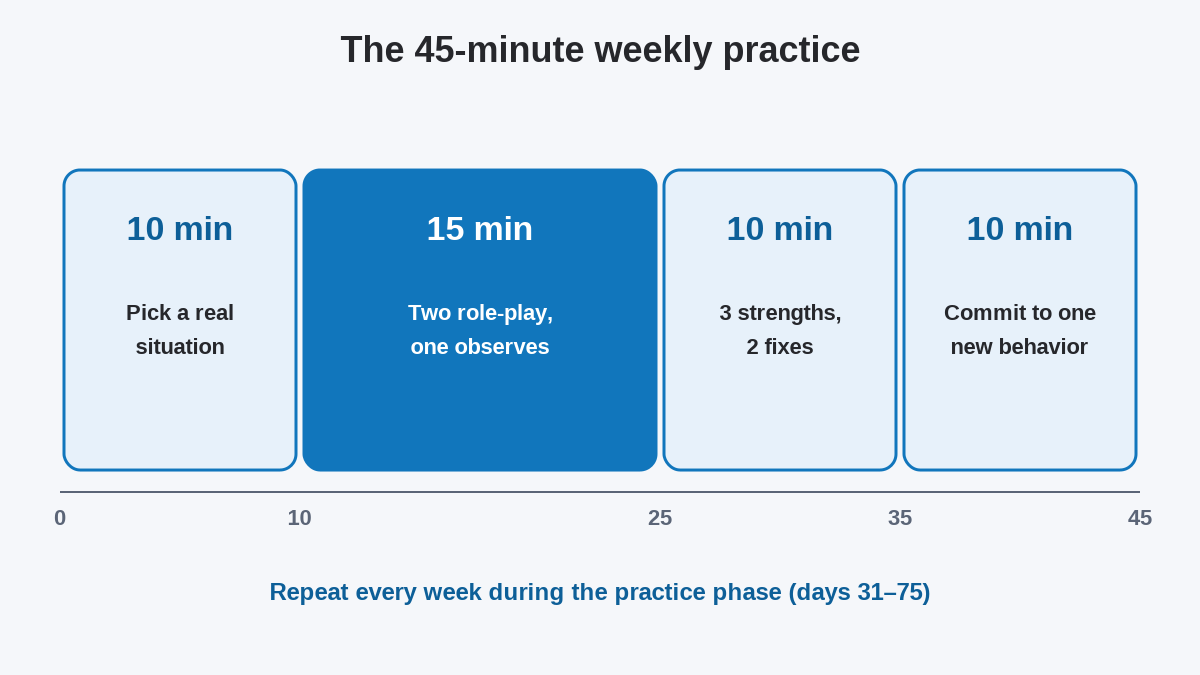
This week, book the first practice session into a fixed slot, say 8 a.m. every Friday. A meeting already in everyone's calendar beats any promise to "practice when we have time."
The 90-day sales training framework
Use this as a starting point and adjust it to your industry and team size:
| Phase | Main work | Owner |
|---|---|---|
| Days 1–14: diagnose | Review numbers, listen to a few calls, quickly ask staff and customers; set 1–2 goals | Business owner, managers |
| Days 15–30: foundation | One hands-on workshop on the process and core skills; agree on scoring criteria | Internal or external trainer |
| Days 31–75: practice | Weekly role plays, one-on-one coaching every two weeks, one-page refreshers | Sales manager |
| Days 76–90: review | Compare metrics before and after, ask staff what helped, decide to continue or change content | Business owner |
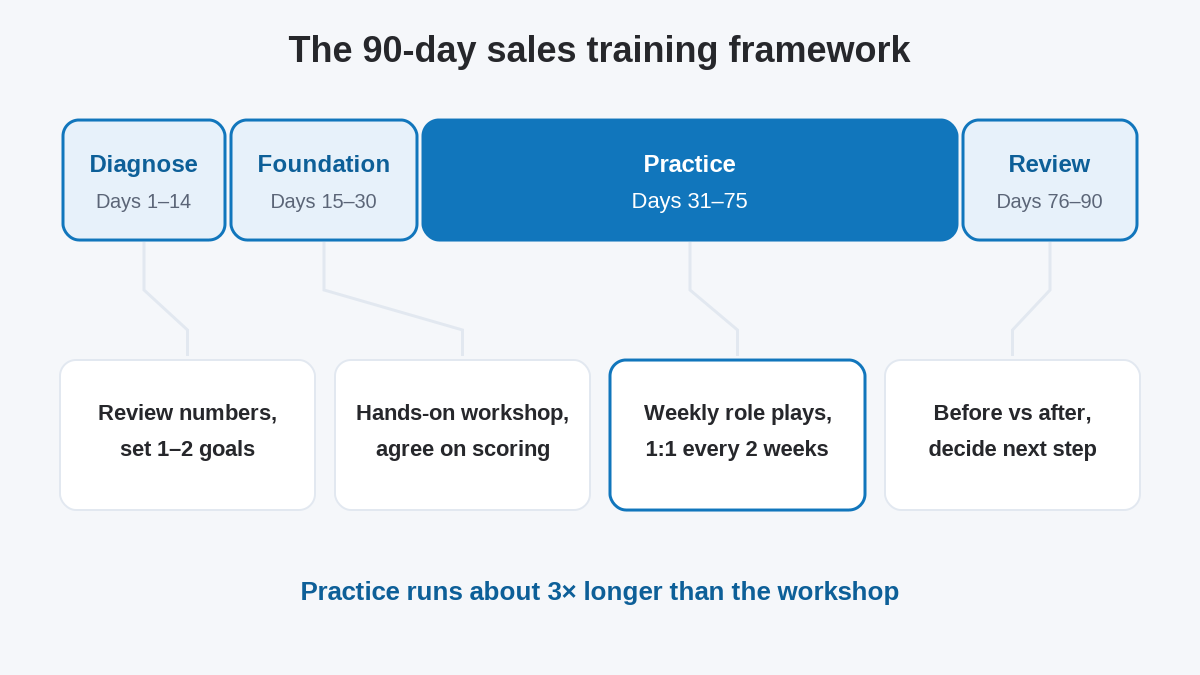
Look at the timeline again: across all 90 days, the main workshop takes roughly two weeks, while the practice phase runs three times as long. That ratio is deliberate. Sales skills behave more like muscles than knowledge: reading about push-ups, however carefully, never made anyone's arms stronger.
Measuring training fairly
Kirkpatrick splits evaluation into four levels: learner reaction, knowledge and skills gained, behavior change on the job, and business results. A small company doesn't need an elaborate four-level system, but it should track at least two: behavior (what managers observe) and results (the metrics chosen in Step 1).
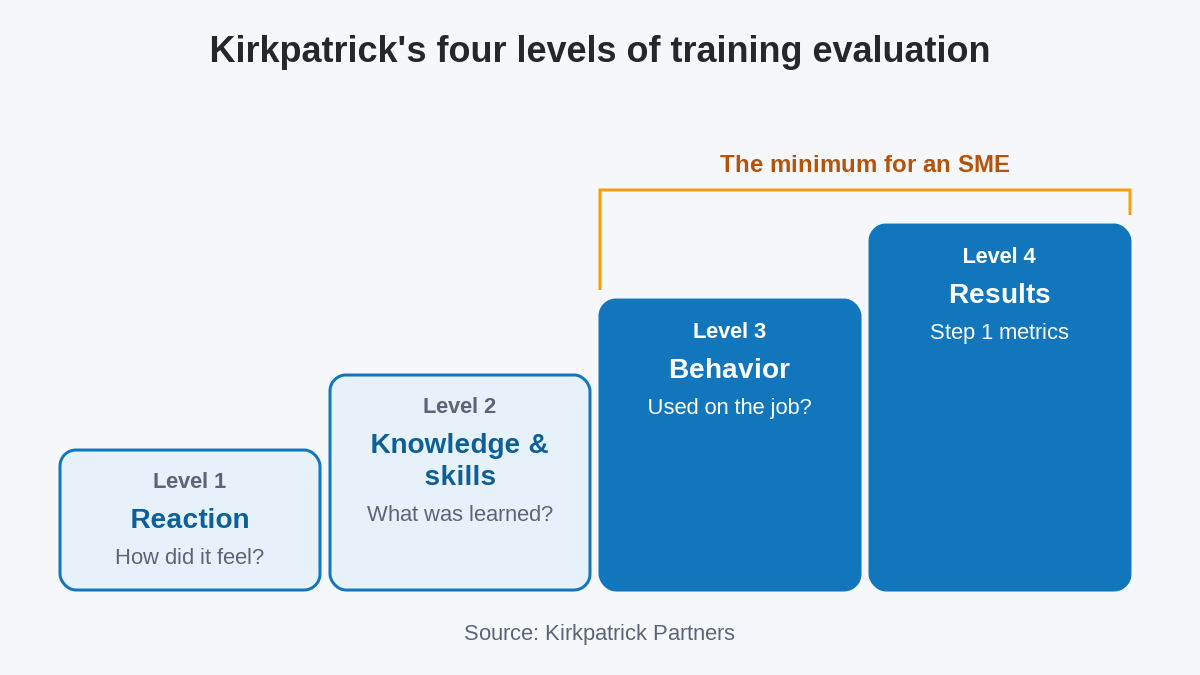
One more word on fairness: sales are also shaped by seasonality, pricing and the market, so don't credit training with every change. Thank the course for every good month and you shortchange your reps; blame it for every bad month and you shortchange the trainer.
A checklist before you spend on sales training
Before you sign with any training provider, spend ten minutes on these six questions:
- Can you state the problem in one sentence and name the metric?
- Does the content follow your real sales process?
- Are learners split by tenure or role?
- Have managers been shown how to coach?
- Is there a practice schedule for at least six weeks after the main session?
- Does someone own the day-90 review?
To try one piece straight away, our training series Optimizing SME Sales with AI includes short exercises for mapping your team's sales process.
Four ticks out of six already puts you ahead of most box-ticking training programs. The other two can wait a week.
How Kingsley Asia can help
The part we care most about isn't the workshop; it's the weeks after it. We help your managers set up the weekly practice, review calls and coach each rep through to day 90. Before that, we look at your sales process and shape the program around the team's real problem, and the coaching comes from specialists in the Kingsley Asia network who have done the job themselves. More on the Sales & Marketing Excellence page, and if your last training left little more than a binder, let's talk about what stuck and what didn't.
Sources
- Highspot – Effective sales training program (accessed 2026)
- Salesforce – Sales training programs (accessed 2026)
- Kirkpatrick Partners – The Kirkpatrick Model (accessed 2026)

Kingsley Asia
The Kingsley Asia consulting team – helping Vietnamese SMEs and international investors from strategy to execution.