
It's Thursday night, you're scrolling Facebook, and a beige jacket stops your thumb. You message the shop's page to ask whether there's a size M; five minutes later the staffer replies "yes, we have it!", sends the bank details, and you pay on the spot. Friday morning your phone rings. The shop is calling to apologise: the last one sold on an online marketplace the afternoon before. You ask whether another branch has one, and the voice on the line promises to "check and get back to you". By lunchtime you have your refund and a cheerful "next time, then!" (illustrative example).
On the buyer's side, all you lost was an evening and a little excitement. The shop lost more: a staffer's morning spent apologising, an order, and very likely a customer. Three or four channels were selling at once, and none of them knew what the others had just done.
An omnichannel sales system exists so that story doesn't repeat itself: customers buy and get help through any channel, while the business sees one shared picture of the customer, the stock and the order. If you were that buyer, would you message that shop again?
Multichannel and omnichannel are not the same thing
Picture three siblings sharing a household, each keeping their own spending notebook. Money still comes in and goes out, but at the end of the month nobody knows what the family actually spent, and every so often all three come home with a sack of rice. Selling in several places without shared data works exactly the same way.
Most sources agree on the core distinction: whether your channels share data.
- Multichannel: you sell in several places, but each runs separately, with its own stock, customer records and experience. A shopper who starts in one channel often has to start over in another.
- Omnichannel: channels share customer data, inventory and order history, so the experience is continuous. A sale in one place updates all the others.
- Unified commerce: some vendors use this term for the back-end foundation, where customer profiles, stock, point of sale, orders and fulfilment all sit on one platform.
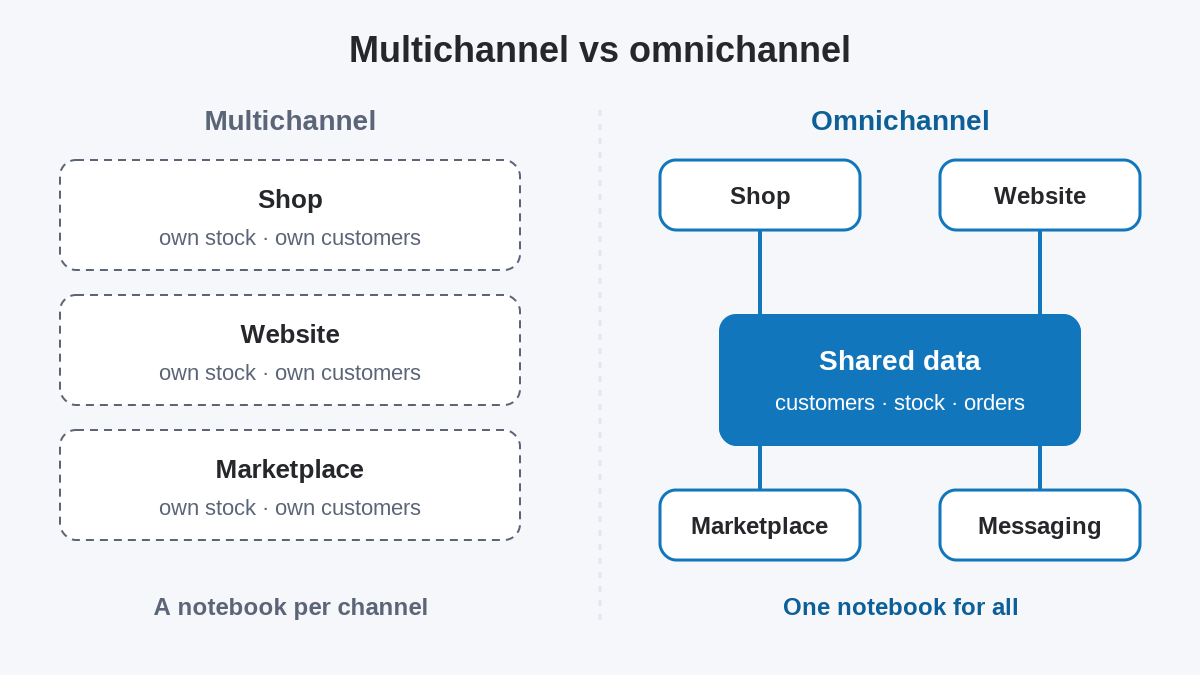
Most businesses get there in stages, starting multichannel and integrating gradually. That's perfectly normal, and there's no shame in still being at the first stage. One thing worth knowing, though: most of these explanations come from software vendors such as Shopify, Zoho and Salesforce, who sell integrated tools. Learn from them, but treat their framing as one perspective rather than the final word.
A quick test: pick one best-selling product and ask every channel the same question, "How many do we have left?" One number per channel, all different, tells you exactly which stage you're at.
Why omnichannel matters, and what the evidence says
A widely cited study published in Harvard Business Review (2017) followed about 46,000 shoppers at a major U.S. retailer. Customers who used several channels spent more than single-channel customers: on average about 4% more per store shopping occasion and 10% more online. The authors themselves caution that the data is correlational. Multichannel shoppers are more valuable, yes, but that doesn't prove that adding channels causes them to spend more.
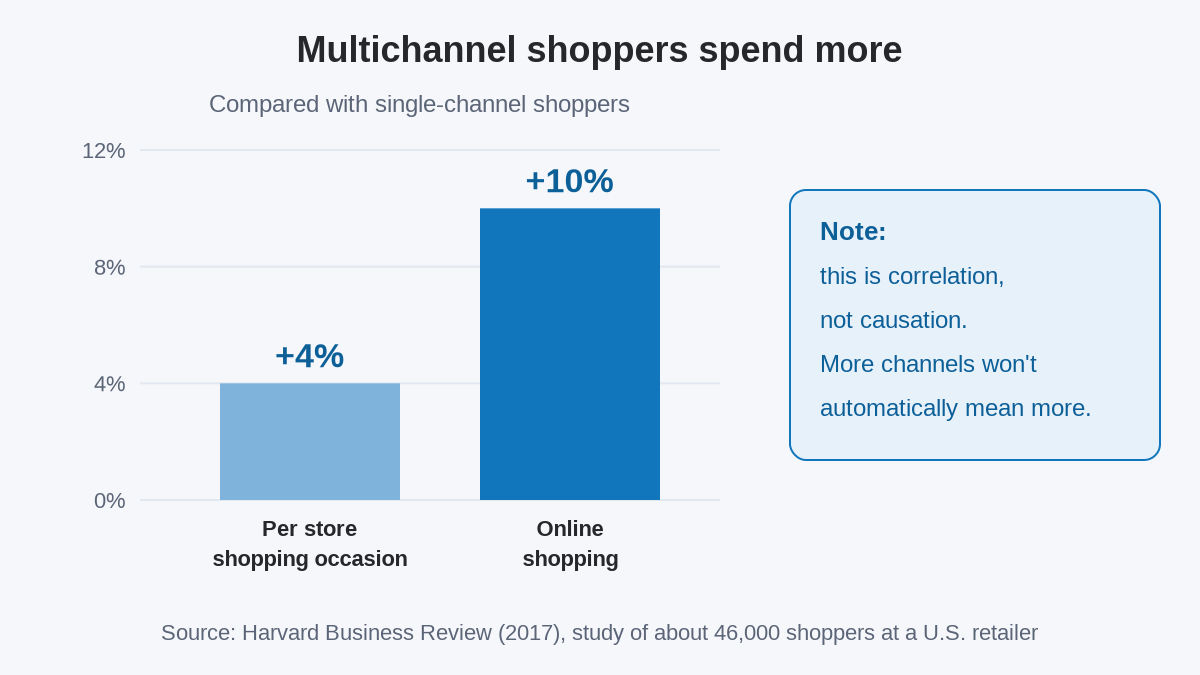
That small caveat is worth remembering, because it saves you from an expensive mistake: opening new channels just because "omnichannel grows revenue." Buying a second fridge doesn't make dinner any better if nobody does the shopping or the cooking.
In Vietnam, online selling is growing fast. According to the Ministry of Industry and Trade (December 2025), e-commerce reached about US$31 billion in 2025, up 25.5% and roughly 10% of total retail sales of goods and services. The national e-commerce master plan for 2026-2030 (Decision 1568/QD-BCT) targets e-commerce at 20% of total retail sales of goods. Vietnamese shoppers now scroll social media, check prices on a marketplace and then walk into a shop, or the other way around. A shared view of the customer is no longer a "someday" project.
The building blocks of an omnichannel system
If an omnichannel system were a house, your sales channels would just be the doors and windows. What keeps the house standing is the foundation and the wiring and plumbing hidden behind the walls. The table lists those six foundations, each with a version sized for a small business.
| Block | What it does | Small-business version |
|---|---|---|
| Customer record | One profile per customer across channels | A CRM with phone number or email as the key; see our guide to CRM for small businesses |
| Inventory and orders | One stock figure, one order list | An inventory or order-management tool, or one master sheet to start |
| Product information | Same names, prices and photos everywhere | One product catalogue copied to each channel |
| Payments and invoicing | Consistent prices, promotions and receipts | A single price list and promotion calendar |
| Fulfilment | Delivery, pickup and returns that work across channels | Clear rules on where returns are accepted |
| Reporting | Sales by channel, source and customer | A weekly dashboard of five numbers |
Tick off which blocks you already have and which are still empty. "Inventory and orders" is usually the one to fix first, because that's where the apology calls come from.
An eight-step plan to build your omnichannel system
Nobody teaches a child to ride a bike on the main road. The first wobbly laps happen in the yard. Building an omnichannel system deserves the same patience: get one channel running smoothly before you add the next.
- List your channels honestly. Include shop, website, marketplaces, social selling, phone, messaging apps and agents. Next to each, note whether it brings revenue or only creates work.
- Choose the channels you can serve well. A few channels done properly will always beat many done badly.
- Fix the data first. Standardise product names, SKUs and prices, and decide the key that identifies a customer, such as a phone number.
- Connect stock. This is the step that stops you selling what you don't have. If a full integration is too much, start with your best sellers.
- Define the handoffs. For example (illustrative): every enquiry from a messaging app is logged in the CRM with an owner and a follow-up date, and whether online orders can be collected or returned in store is written down as a clear rule.
- Set service rules. Decide response times, who answers, and what happens after hours.
- Pilot, then extend. Integrate two channels, measure for a month, then add the next one.
- Review by customer, not only by channel. Look at which channels customers use together and where they drop out.
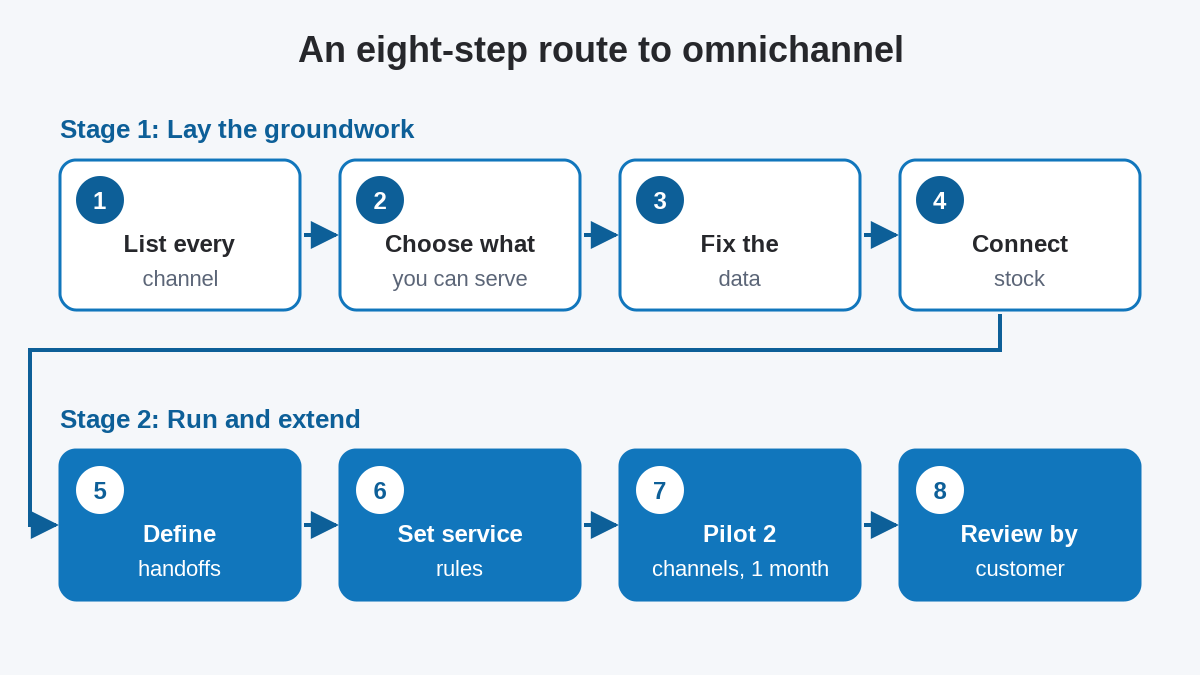
Step 1 takes a single session with your team: list every channel you have, honestly, with three months of revenue for each. Sometimes the channel that eats the most effort turns out to bring in the least money.
Five places growing businesses trip up
A new channel opens, the team runs itself ragged, and revenue barely moves. It happens a lot, and the cause usually traces back to one of these.
- Opening every channel at once, spreading the team so thin that every channel gets only token attention.
- Different prices or promotions by channel without a clear reason. Customers compare prices in seconds on their phones, so this erodes trust fast.
- No single owner of customer data. Information ends up living in individual phones.
- Buying a large platform before the process exists. Tools amplify a process; they never replace one.
- Ignoring personal data rules. According to the Government Official Gazette, Vietnam's Law 91/2025/QH15 on personal data protection took effect on 1 January 2026. If you combine customer information across channels, follow it and take legal advice.
Note: The legal information in this article is a summary based on the Kingsley Asia team's analysis of documents and sources published at the time of writing (11/2026). Policies may change; please confirm with a lawyer or accountant before acting on it.
Customers never see your system diagram. What they remember is whether somebody had to ring them on a Friday morning to apologise.
How Kingsley Asia can help
We usually start with a single best-seller of yours: we follow it through every channel to find where the stock figures drift apart and where customers get dropped mid-journey, and only then talk about handoff rules and tools. Our sales and marketing service page has more detail, and you can book a conversation here. If AI-assisted selling is on your list, our training series Optimizing SME Sales with AI is the place to continue.
Sources
- Shopify – Omnichannel vs. multichannel
- Zoho Commerce – Omnichannel vs. multichannel
- Zoho Inventory – Multichannel vs. omnichannel vs. unified commerce
- Salesforce – What is omni-channel retail?
- BigCommerce – Omnichannel vs. multichannel retail
- BARE International – Study shows omnichannel retailing works (summary of Harvard Business Review, 2017)
- Harvard Business Review – A Study of 46,000 Shoppers Shows That Omnichannel Retailing Works (2017)
- Ministry of Industry and Trade – E-commerce and Digital Economy Agency 2025 review (2025)
- Ministry of Industry and Trade – National e-commerce master plan 2026-2030 approved (2025)
- Vietnam Government Gazette – Law No. 91/2025/QH15 on Personal Data Protection (2025)

Kingsley Asia
The Kingsley Asia consulting team – helping Vietnamese SMEs and international investors from strategy to execution.