
A foreign managing director flies into Hanoi for his first business trip (an illustrative case). The meeting is warm, lunch runs long, and his hosts ask about everything from his family and hometown to whether the flight was tiring. Every proposal he puts on the table is met with a smile and a "yes". He flies home and tells the office the deal is as good as done. Three weeks later his inbox is strangely quiet, and he finds himself counting back through a dozen yeses, trying to work out which one actually meant yes.
That story holds most of what a foreign partner needs to know about Vietnamese business culture. Relationships usually come before contracts, decisions tend to sit with senior people, and politeness is sometimes expressed in the very words a visitor hears as commitment. Practice also varies by region, industry and company ownership, so treat what follows as a starting point rather than a rulebook.
Vietnamese has six tones. The word "vâng" seems to carry rather more meanings than that.
Relationships Come Before Transactions
How did you choose your family doctor or your lawyer back home? You probably did not pick the one with the cleverest advertisement; you picked the one a friend trusted. Doing business in Vietnam often works the same way, only more so. Several guides, including Vietnam Briefing, describe trust and personal connection as the foundation of business here. Expect more than one meeting before anything formal is discussed, and expect questions about your background, family or trip that may feel personal. They are meant to build familiarity, not to pry, and a friendly answer goes a long way.
Introductions through a mutual contact usually work far better than cold outreach. A partner or advisor who already has trust on both sides can shorten the getting-to-know-you stage considerably, a bit like borrowing a friend's good name for the first conversation.
One practical caution belongs right here, though. Close relationships are not a substitute for clear contracts, due diligence and compliance. Treat the relationship as the door into the deal, and the paperwork as the lock that keeps everyone safe once you are inside.
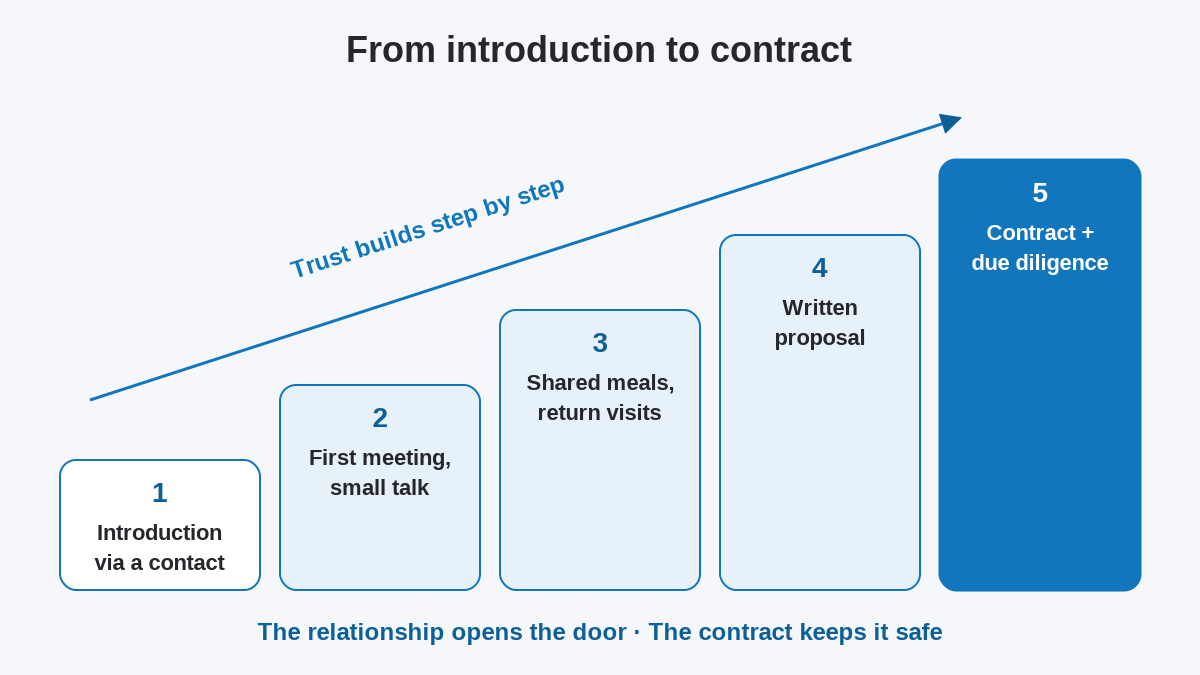
Relationships open the door. Contracts keep it from slamming shut.
Ahead of your next trip, ask yourself one question: who could introduce us? If you can name one person who knows both sides, start there.
Hierarchy and How Decisions Are Made
Sit through one family dinner where the eldest person is served first and nobody touches the dish until they do, and you already understand a good deal about Vietnamese meeting rooms. Seniority matters. In meetings, the most senior person is typically greeted first, seated first and handed a business card first. Sources describing decision-making agree that authority is often concentrated at the top, and that junior staff may hesitate to contradict a superior in public.
Here is what that means for you in practice:
- Find the real decision-maker. The person who attends every meeting and answers every email may not be the one who approves the deal.
- Give senior people visible respect, and send a counterpart of comparable seniority from your side when the stakes are high.
- Allow time for internal approval. Decisions may pass through several levels, especially in state-owned or large organisations.
- Do not apply pressure. Visible impatience tends to backfire, and "we need an answer by Friday" can quietly move your file to the bottom of the pile.
Draw a simple chart of your counterpart's organisation, even if it has question marks in it. Put a star next to the person you think signs, and make it your goal to meet them, or at least to understand what they care about.
Negotiation, the Polite "Yes" and Saving Face
Open disagreement and public criticism are generally avoided in Vietnam, because they cause a loss of face, meaning damage to someone's dignity and standing. Concerns are better raised privately and politely, ideally over a coffee rather than across a conference table full of colleagues.
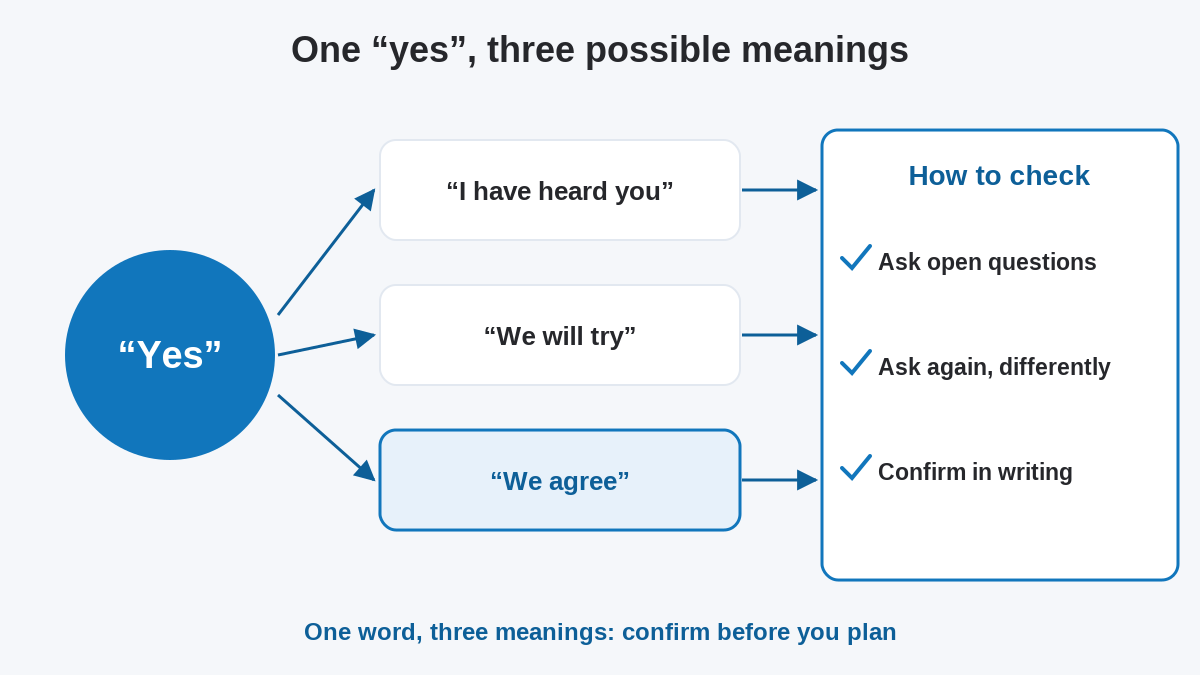
This shapes how you read answers. A supplier guide from Cosmo Sourcing notes that a Vietnamese "yes" can mean "I have heard you" or "we will try" rather than a firm commitment, and that a quick yes to a tight deadline is a weak signal. The word stays the same; the meaning shifts with the moment. Four practical ways to handle it:
- Ask about the same issue in different ways and listen for hesitation, because the pause often says more than the answer.
- Ask open questions such as "Which step in the process takes the longest?" instead of "Can you deliver on this date?"
- Confirm the key points in writing, with diagrams or photos wherever they help.
- Send a short email after each meeting summarising what was agreed and who does what next.
On price, the same source suggests that quotes often improve after a second or third conversation, or after a visit in person. Try not to squeeze every last concession out of a first order. Leaving a little room for your partner tends to build a longer relationship, and long relationships are where the real margins usually live.
Next time you hear a quick "yes" to something difficult, smile, say thank you, and then ask: "What would need to happen for this to work?" The answer will tell you far more than the yes did.
Meetings, Greetings and Everyday Etiquette
None of the points below will make or break a deal on their own. Together, though, they send a quiet signal that you have done your homework, and in a relationship-driven culture that signal is worth a great deal.
| Situation | Common practice |
|---|---|
| Greeting | Handshake with a slight nod; a few words of Vietnamese are appreciated |
| Business cards | Offer and receive with both hands, read before putting away; Vietnamese-English bilingual cards look professional |
| Names | Family name first, then middle name, then given name; ask how to address someone |
| Meetings | In-person is preferred when relationships are new; book in advance |
| Dress | Formal for government, banks and large companies; sector and city vary |
| Gifts | Small gifts such as fruit or sweets for a home visit; avoid items in black packaging |
| Business meals | Wait for the host to begin eating; meals are for building rapport, not closing |
Source for the table: Vietnam Briefing's business etiquette guide, paraphrased.
The Best Ice-Breaker We Know: Give Yourself a Vietnamese Name
Most guidebooks skip this tip, and it tends to work better than any gift in your suitcase. Before your trip, spend half an hour picking a short, easy-to-say Vietnamese name for yourself, and find out what it means. Then, when you introduce yourself, say something like: "My name is John, but you can call me Tuấn." And have a one-line reason ready, because someone will ask. A few examples to get you started:
- John → Tuấn. "Tuấn means handsome and talented. I'm still working on at least one of those."
- Sarah → Mai. "Mai is the apricot blossom that comes out at Tet, the start of the good times, which is exactly how I'd like to arrive at every meeting."
- Michael → An. "An means peace and safety, and it's the only Vietnamese word I can say without making the waiter laugh."
Why does it work so well? First, it sparks curiosity: "Why Tuấn?" is a question people genuinely want answered. Second, it usually earns a laugh, and a room that has laughed together in the first five minutes is a much easier room to negotiate in. Third, it hands everyone a ready-made piece of small talk, so the awkward silence before the agenda simply never arrives. Most of all, it shows respect and effort. You have not just learned how to pronounce their names; you have stepped, a little playfully, into their language.
It also mirrors something your Vietnamese counterparts have been doing for you for years. Many of them already carry an English name such as Linda, Kevin or Tony on their business cards, and some who work with Chinese, Korean or Japanese partners use a name in that language too, simply to make life easier for the other side. Choosing a Vietnamese name is your chance to return the favour.
One sensible precaution: run your choice past a Vietnamese colleague or friend first. Vietnamese is tonal, and a name that looks lovely on paper can, with the wrong tone, become something else entirely. Two minutes of checking saves you from introducing yourself as a type of soup.
A quick note on addressing others: because the given name comes last, a Mr Nguyen Van Minh is usually called by his given name, often as "anh Minh" (literally "older brother Minh") or "Mr Minh"; a woman of similar standing might be "chị Lan". When in doubt, simply ask how they would like to be addressed. People nearly always appreciate the question, and you avoid calling half the room "Mr Nguyen".
Planning Around Tet
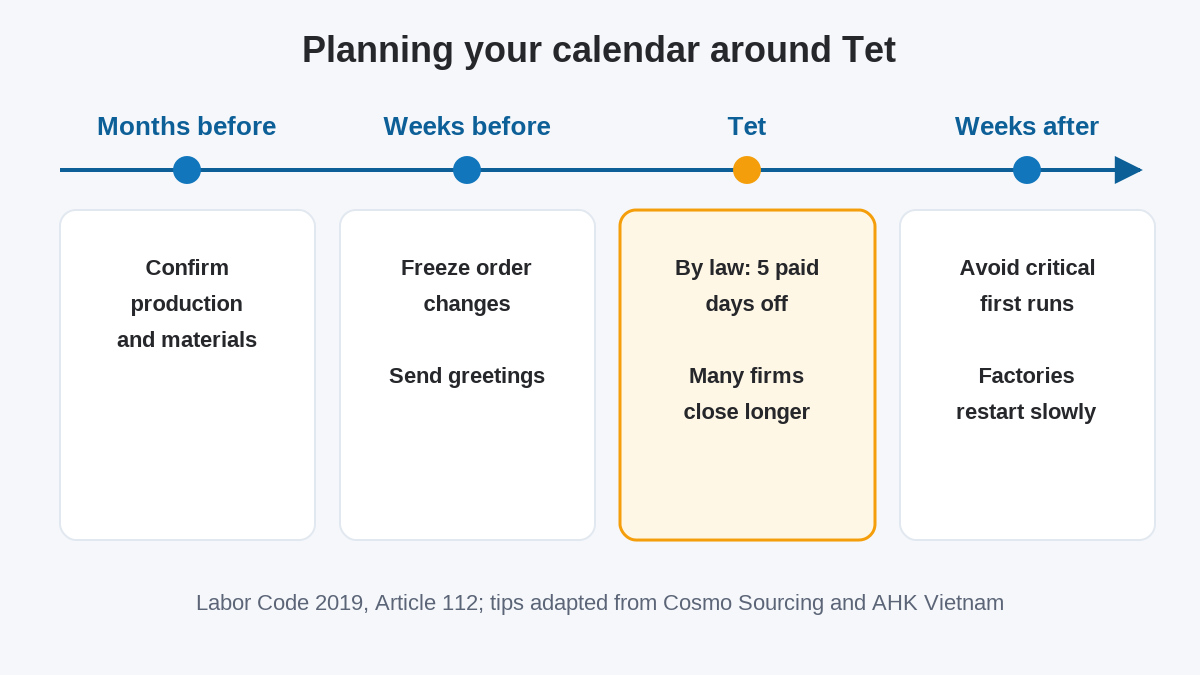
Tet, the Lunar New Year, is the most important holiday of the year in Vietnam, and it shifts between late January and mid-February. Think of it as Christmas, New Year and a family reunion rolled into one, with the travel to match. Under Article 112 of the 2019 Labor Code (as published in the Official Gazette), employees are entitled to five fully paid days off for Tet, but many companies and factories close longer, and travel before and after the holiday slows everything down.
Note: The legal information in this article is a summary based on the Kingsley Asia team's analysis of documents and sources published at the time of writing (11/2026). Policies may change; please confirm with a lawyer or accountant before acting on it.
A suggested approach, adapted from supplier-side guidance:
- Confirm production and materials well before the holiday, ideally several months ahead if you are manufacturing.
- Avoid scheduling an important first production run in the weeks right after Tet, when staff turnover and a slow restart are common.
- Avoid changing existing orders in the weeks before the break, because informal agreements may not be acted on while everyone is preparing to travel home.
- Send greetings. AHK Vietnam's material notes that festive greetings and Tet bonuses help strengthen relationships.
Looking up next year's Tet dates and blocking out a quiet period around them takes about five minutes. Those five minutes can save you from a shipment stuck in a factory with the lights switched off.
A Short Checklist Before Your First Meeting
- Identify who really decides, and who influences.
- Arrange an introduction rather than a cold approach.
- Prepare bilingual business cards and materials.
- Plan several touchpoints, not one big pitch.
- Agree on written follow-up after each meeting.
- Check the Tet dates before proposing any timeline.
If you are weighing Vietnam as a production base, our overview of China+1 and why Vietnam keeps making the shortlist is a useful companion read.
How Kingsley Asia Can Help
Before you travel, we can find the right person to introduce you through the local specialists we work with, sketch out who actually signs on the other side, and after each meeting help you decode the yeses you just heard. The details are on our Vietnam market entry service page; once your flight dates are fixed, let us know early enough to line up the meetings.
Sources
- Vietnam Briefing – Business Etiquette in Vietnam: A Guide for Foreign Investors and Executives
- Cosmo Sourcing – Vietnamese Business Culture: Working with Suppliers, Communication and Tet Planning
- Vietnam Official Gazette – Labor Code No. 45/2019/QH14, Article 112 (2019)
- AHK Vietnam – Business culture material (German Industry and Commerce Vietnam)
- Source of Asia – Vietnam business culture guide for foreigners

Kingsley Asia
The Kingsley Asia consulting team – helping Vietnamese SMEs and international investors from strategy to execution.