
Foreign investment actually disbursed in Vietnam reached an estimated US$27.62 billion in 2025, up 9% and the highest in five years, according to figures published in January 2026 by the Statistics Office and the Foreign Investment Agency under the Ministry of Finance. More than four-fifths of it went into manufacturing and processing. And there's a detail in the same data that deserves more attention than it gets: China ranked second by total registered capital and first by number of new projects. Chinese manufacturers themselves are building bases in Vietnam.
Behind those figures sits a strategy with a now-familiar name, China+1: keep part of your sourcing or production in China, add at least one more country, and make sure a single tariff, port closure or lockdown can't stop the whole line. Vietnam is one of the most popular choices for the "+1".
Why should that matter to you this year? If you manufacture abroad, your biggest customers may soon ask you to confirm a second source. If you run a business in Vietnam, those new plants will need suppliers, logistics partners and local talent. Either way, start from one hard fact: Vietnam is not a smaller, cheaper copy of China, and companies that treat it as one tend to get surprised.
Note: The legal information in this article is a summary based on the Kingsley Asia team's analysis of documents and sources published at the time of writing (11/2026). Policies may change; please confirm with a lawyer or accountant before acting on it.
What China+1 Really Means for Your Business
Think of it the way a pilot thinks about a twin-engine aircraft. Nobody switches off the good engine just because a second one is fitted; the point is that if one engine coughs, the plane can still land safely. China+1 works in exactly the same spirit. It is a risk-management approach, not an exit. Most companies that adopt it keep their existing Chinese operations, because China still offers deep supplier networks and enormous scale. The "+1" is a second base that lowers your dependence on any single location.
The triggers tend to be familiar to anyone who has sat through a few supply-chain meetings: tariffs and trade tension, customers asking for a second source, rising costs, and the wish to sit closer to Asia's fast-growing markets. Bain & Company's analysis of relocation makes a point worth pinning above your desk: moving from one country to another does not make risk disappear, it simply changes the kind of risk you carry.
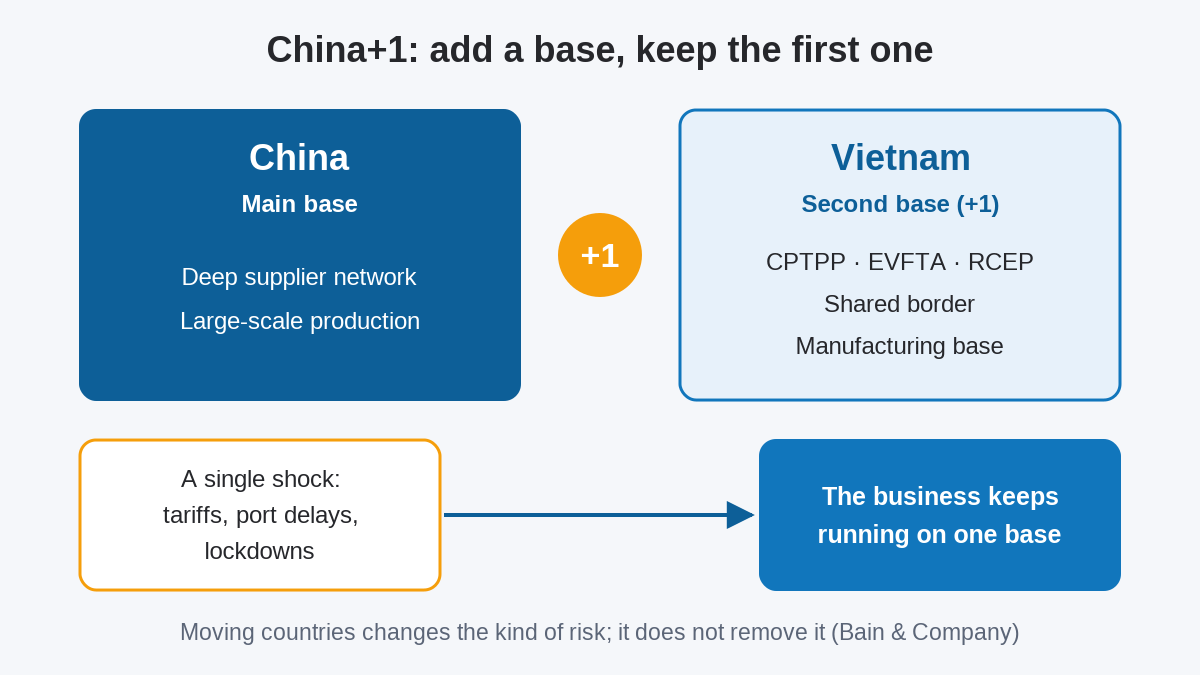
Diversify your risk, not just your address.
This week, try one small exercise. Write down your ten most important components or products, and next to each one, note the country it comes from. If a single name fills most of the column, you already know where your China+1 conversation needs to start.
Why Vietnam Keeps Making the Shortlist
Choosing a location for a new shop comes down to a few questions everyone knows by heart: Who walks past? Where are my suppliers? Can I get my goods in and out easily? Manufacturers choosing a "+1" ask very similar questions, just with bigger trucks and longer contracts. Across reputable sources, four answers keep coming back for Vietnam:
- Trade access. According to Vietnam's Ministry of Industry and Trade, the CPTPP has been in force for Vietnam since 14 January 2019, the EU-Vietnam FTA (EVFTA) since 1 August 2020 and RCEP since 1 January 2022.
- Location. Vietnam shares a border with China, which makes it practical to keep your existing Chinese suppliers in the loop rather than starting from zero.
- Manufacturing base. Electronics, textiles, furniture and machinery have been established here for years, so you are rarely the first company in your industry to arrive.
- Government focus. Industrial parks and investor-support programmes are actively promoted.
Notice what is missing from that list: "cheap labour, end of story". Cost matters, of course. But the companies that tend to do well here usually chose Vietnam for access and capability, and treated cost as a welcome bonus rather than the entire business case.
What the 2025 FDI Figures Tell Us
Numbers are where enthusiasm meets reality. Here is the full picture, according to figures published in January 2026 by the Statistics Office and the Foreign Investment Agency, both under Vietnam's Ministry of Finance:
| Indicator (2025) | Figure |
|---|---|
| Total registered FDI (new, adjusted and share purchases) | US$38.42 billion (up 0.5%) |
| Disbursed FDI | estimated US$27.62 billion (up 9%, highest in five years) |
| Share of disbursed FDI in manufacturing and processing | 82.8% (US$22.88 billion) |
| Newly registered capital | US$17.32 billion across 4,054 projects |
| Top three partners by total registered capital | Singapore (about US$9.4 billion), China (about US$5.7 billion), South Korea (about US$5.3 billion) |
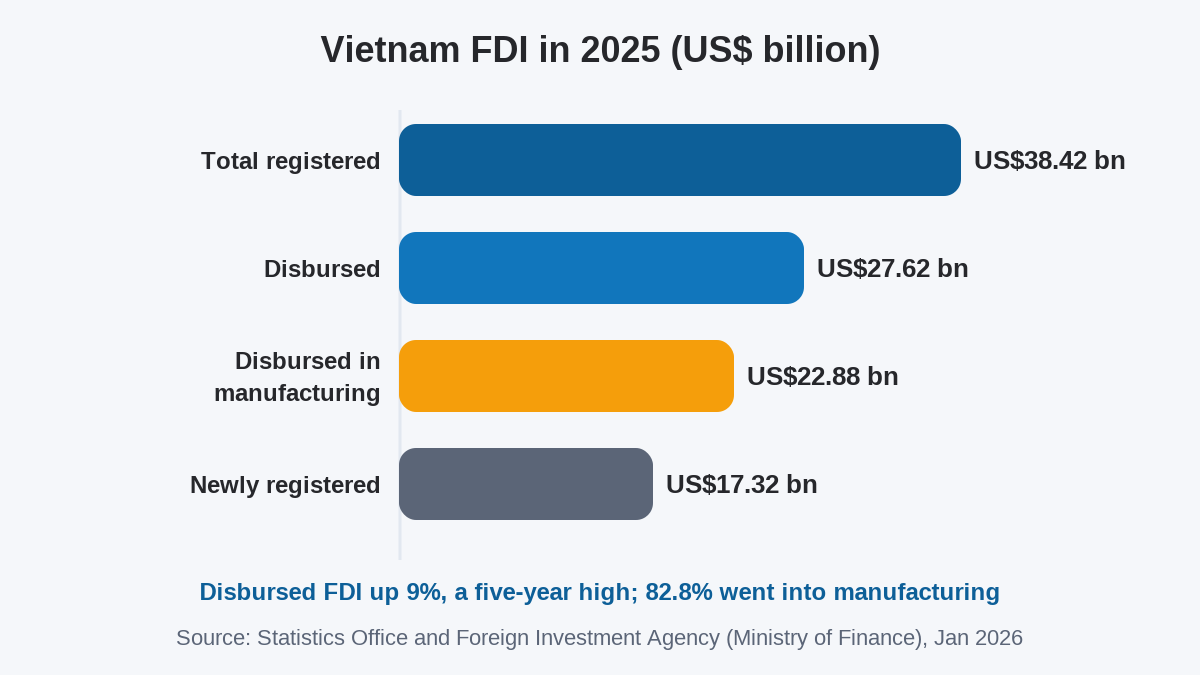
We would draw two readings from this table. The first is about disbursement, meaning money actually spent, which rose 9% to its highest level in five years. Announcements cost very little; concrete, steel and payroll cost a great deal. When disbursement climbs, it usually means factories are being built rather than simply celebrated at a signing ceremony.
The second reading surprises many people: China itself is the second-largest partner by total registered capital and leads by number of new projects. So Chinese manufacturers are diversifying into Vietnam as well, so a Vietnam-based supply chain often still has Chinese content in it. Your suppliers' suppliers may well be companies you already know. One honest caveat belongs here too. These figures do not tell you how much investment comes from China+1 specifically, so any number that claims to measure it is an estimate, not a statistic.
Before your next board meeting, keep one simple lens in your pocket: registered capital tells you about intentions, while disbursed capital tells you about commitment. It works for reading almost any investment headline, in Vietnam or anywhere else.
The Risks and Limits Worth Planning For
We have all seen the kind of business plan that only works if everything goes right, usually written in a hurry the week before a holiday. Please do not build your "+1" on the optimistic version alone. These are the five limits we would put on the table first:
- Vietnam still imports many inputs from China. A manufacturer interviewed by CKGSB described Vietnam as complementing China rather than replacing it, with local supply chains less mature and some inputs still imported. Your bill of materials may cross the border more often than your slide deck suggests.
- Skills and training. The same source points to gaps in technical roles such as mechanics and electricians. In practice, that means a bigger training budget and a slower ramp-up for new hires than you might be used to.
- Scale. Analysts at LSEG argue that Vietnam's size limits how much of China's role it can absorb. Vietnam can be an excellent second engine; it was never designed to carry the whole aircraft.
- Trade policy exposure. Bain notes that economies like Vietnam can themselves become targets of tariff pressure, and policies may change. Rules of origin and documentation therefore deserve attention from day one, not the week before your first shipment.
- A changing tax environment. According to the Government's official news portal, Decree 236/2025/ND-CP was issued on 29 August 2025 and took effect on 15 October 2025, detailing how the global minimum tax (OECD Pillar Two) applies to large multinational groups. Smaller companies are usually outside its scope, but groups above the threshold should have their tax advisors review incentive assumptions.
None of these is a reason to stay away. They are reasons to plan properly, in the same way that a good sailor checks the weather, not out of fear of the sea, but out of respect for it.
Your China+1 Preparation Checklist
We suggest going through this list with your operations, finance and sales leads in the same room, before anyone signs a lease or a contract.
- Define the goal. Do you need a second production site, a second supplier, or a market-entry move to sell in Vietnam? Each goal calls for very different preparation.
- Map your supply chain. List which components can be sourced locally, which must still come from China, and the lead time of each.
- Test labour and skills. Check whether the roles you need exist in your target province, and set aside a realistic budget for training.
- Check logistics and utilities. Visit the sites in person. Ask about power reliability, port access and transport times to your customers.
- Choose the entity route. Compare a representative office, a foreign-owned company, a joint venture or contract manufacturing. Each route differs in licensing, control and cost, so take advice before choosing.
- Confirm tariff and origin rules with a customs or trade advisor before promising delivery terms to your customers.
- Plan for people and culture. Decisions, negotiation and holiday calendars work differently here. Our practical guide to Vietnam business culture is a good place to start.
- Start small. A pilot order or a short contract-manufacturing run reveals problems while they are still cheap to fix.
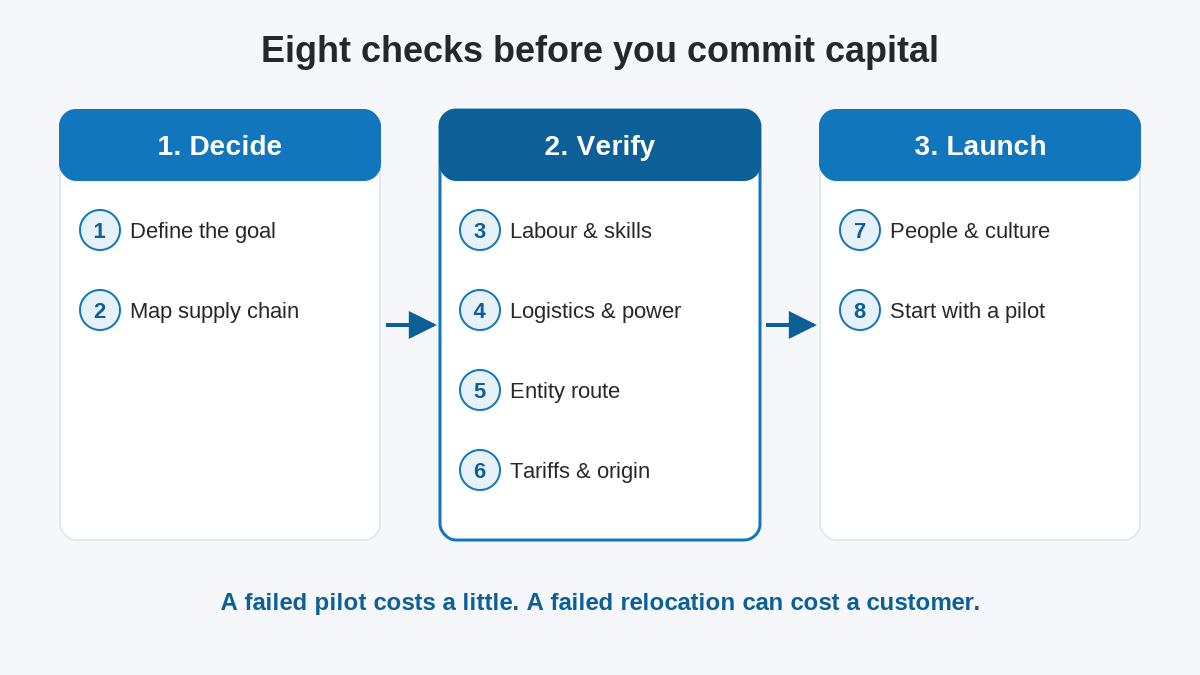
The first two items, a one-sentence goal and a one-page sketch of your supply chain, are plenty for month one. A pilot order that goes wrong costs you a little time and money; a full relocation that goes wrong can cost you a customer, and customers tend to have long memories.
How Kingsley Asia Can Help
Before you commit capital, Kingsley Asia can play the role of the person asking awkward questions: stress-testing your supply-chain and cost assumptions, comparing entry routes, and introducing you to customs, legal and HR specialists in our Vietnam network. Our Vietnam market entry service sets out how that works; the best time to contact us is before your first site visit, while every option is still open.
Sources
- General Statistics Office (Ministry of Finance) – Socio-economic situation press release, Q4 and full year 2025 (2026)
- General Statistics Office – Manufacturing attracted the most FDI in 2025 (2026)
- Foreign Investment Agency (Ministry of Finance) – FDI report, 12 months of 2025 (2026)
- Ministry of Industry and Trade – CPTPP in force for Vietnam from 14 January 2019
- Ministry of Industry and Trade – EVFTA in force from 1 August 2020
- Ministry of Industry and Trade – RCEP in force from 1 January 2022 (2021)
- Vietnam Government News – Government issues decree on the global minimum tax (2025)
- PwC Vietnam – Decree on implementation of Global Minimum Tax rules (2025)
- Bain & Company – From China to Trouble? (2025)
- CKGSB – Moving Manufacturing: Pursuing a China+1 approach (2025)
- LSEG Lipper Alpha – Vietnam's new role in global trade (2024)

Kingsley Asia
The Kingsley Asia consulting team – helping Vietnamese SMEs and international investors from strategy to execution.